Last year, an obscure little word in the Wall Street Journal caught my eye. Not only did it appear in one of the world’s best-known newspapers, but on the front page—in one of its top-of-the-page columns, or what journalists call “above the fold.” And what I read surprised me, made me smile, then had me forwarding the little piece to a dozen people whom I knew would also get a kick out of it. That little word was upma (pronounced OOP-mah), and no one would fault you if you haven’t heard of it. I knew it was but could not have imagined the Wall Street Journal, or the many other major media outlets that carried stories about oopma that day, would ever have reason (or, frankly, the inclination) to mention it at all.
Upma is the simplest of Indian dishes, a savory South Indian “porridge” made from semolina (aka, wheat farina or cream of wheat) and served as either a meal at breakfast or a tea-time snack. It typically includes a minimum of other ingredients—a few vegetables (usually onions, tomatoes, peas, maybe some grated carrot) and a few basic seasonings (ginger, garlic, green chilis, curry leaves, cilantro, with a sprinkling of mustard seeds and split white lentils). Click on this link for a fairly basic recipe. Or click here for a couple dozen other variations. (Hm, macaroni upma?) Here's how to make a sweet dumpling-shaped one, a recipe that hails from India's "deep South."
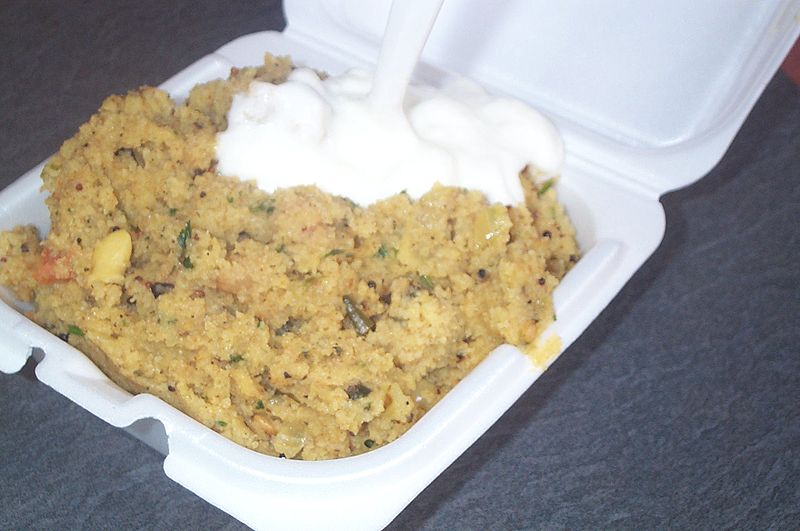 |
| credit: stu_spivack |
Okay, so my list of "minimum" ingredients may sound long and not quite that simple, but just the mere mention of the dish used to (and, okay, until fairly recently) immediately get my eyes rolling. It was a few notches below one of my other least favorites, Raisin Bran. (I abhor raisins.) Given the choice (which happened on occasion), I’d go hungry before digging into a piping hot bowl of fresh-made upma.
Apparently, I was the only one. Upma is generally considered "peasant food," with some foodies comparing it to “fertilizer.” It’s one of the few foods pious Hindus are allowed to eat when they’re fasting (albeit without the onions and garlic, which according to Ayurvedic belief are considered to be “hot” [garam] flavors that induce excessive behaviors). Add to that the old adage about Chinese food—no matter how much upma I ate, I was almost always scrounging for a snack to fill me up soon after.
I did eventually acquire a taste for it a couple years ago when I discovered "Mysore upma," a variation on the aforementioned basic recipe. The trick is to triple the proportion of water to semolina rather than simply doubling it, the the traditional way. The result is a moist, flavorful, and more filling dish than the dry, traditional version that somehow doesn't properly absorb the flavors of all those ingredients.
I did eventually acquire a taste for it a couple years ago when I discovered "Mysore upma," a variation on the aforementioned basic recipe. The trick is to triple the proportion of water to semolina rather than simply doubling it, the the traditional way. The result is a moist, flavorful, and more filling dish than the dry, traditional version that somehow doesn't properly absorb the flavors of all those ingredients.
In any case, I knew few people who'd ever tried upma and even fewer who talked about it. So I had to do a double take when I saw it mentioned on the front page of a major American newspaper. Maybe a triple take.
Not only had upma made the mainstream media but, in order of stunning phrases strung together in the same sentence, 1) a New York chef 2) won $100,000 3) in a cooking contest 4) on Bravo’s Top Chef Masters, 5) a popular American reality show.
Excuse the italics, but it doesn’t get any weirder than that.
I hadn’t forgotten this big news on upma but neither had I registered the name of the prize-winning chef until a year later when he happened to be one of the featured speakers at a Konkani convention I'd attended in New Jersey. It was a bit of a surprise that the famous New York chef who won the Bravo show making, of all things, upma is, yes, Konkani. (Only reconfirming a friend’s assertion that we Konkanis are pretty into ourselves. Except now that “we” won a contest for making upma, I don’t see why we can’t toot our own horn.)

Floyd Cardoz, a Catholic Konkani who grew up in Goa and Mumbai, earned his undergrad degree in biochemistry before studying the culinary arts in Switzerland, working at a world-class restaurant in New York, and eventually opening his own restaurant, Tabla, in 1998. That celebrated venue has since closed, but Cardoz has two new restaurants—North End Grill (a traditional American bar and grill) and El Verano Taquería (a modern-day taco stand, with three locations in the Big Apple). He's also launched a line of gourmet “convenience” foods and written a popular fusion cookbook, generously borrowing flavors from his childhood in both Goa and Mumbai. All of these experiences have resulted in a culinary adventure, his own signature pairings of diverse ingredients such as morels and chilies, figs and cilantro-mint chutney, french fries and mango powder (amchur), scallops and fennel seeds, duck and tamarind. Speaking of which, ever heard of a tamarind margarita? That was one of the recipes he featured on Top Chef Masters.
Fronting his two main courses of rice-crusted snapper in a broth flavored with coriander and fennel and his rendition of a Malaysian beef stew, Cardoz calls his headline-grabbing twist on the old breakfast porridge an “upma polenta,” infused with coconut milk and (gasp) chicken broth, and topped with a melange of exotic wild mushrooms glazed in port wine. The result has been a surprising burst of interest in upma, even all over India, where upma Internet recipe searches have surged, customers at upscale restaurants are requesting the dish, and chefs are creating all kinds of new upma concoctions, including those with such non-traditional ingredients as chicken and seafood.
Following is the three-course meal, with links to the recipes, which won Cardoz the Bravo show’s ultimate prize award of $100,000 (all of which he contributed to charity, by the way):
3rd Course—Rendang 2 Ways: Oxtail & Short Ribs Tapioca Pilaf with Diced Potato & Peanuts


