Showing posts with label Konkani. Show all posts

Wednesday, February 13, 2013

Upma Gets Uppity

By Supriya Savkoor

Last year, an obscure little word in the Wall Street Journal caught my eye. Not only did it appear in one of the world’s best-known newspapers, but on the front page—in one of its top-of-the-page columns, or what journalists call “above the fold.” And what I read surprised me, made me smile, then had me forwarding the little piece to a dozen people whom I knew would also get a kick out of it. That little word was upma (pronounced OOP-mah), and no one would fault you if you haven’t heard of it. I knew it was but could not have imagined the Wall Street Journal, or the many other major media outlets that carried stories about oopma that day, would ever have reason (or, frankly, the inclination) to mention it at all.

Upma is the simplest of Indian dishes, a savory South Indian “porridge” made from semolina (aka, wheat farina or cream of wheat) and served as either a meal at breakfast or a tea-time snack. It typically includes a minimum of other ingredients—a few vegetables (usually onions, tomatoes, peas, maybe some grated carrot) and a few basic seasonings (ginger, garlic, green chilis, curry leaves, cilantro, with a sprinkling of mustard seeds and split white lentils). Click on this link for a fairly basic recipe. Or click here for a couple dozen other variations. (Hm, macaroni upma?) Here's how to make a sweet dumpling-shaped one, a recipe that hails from India's "deep South."
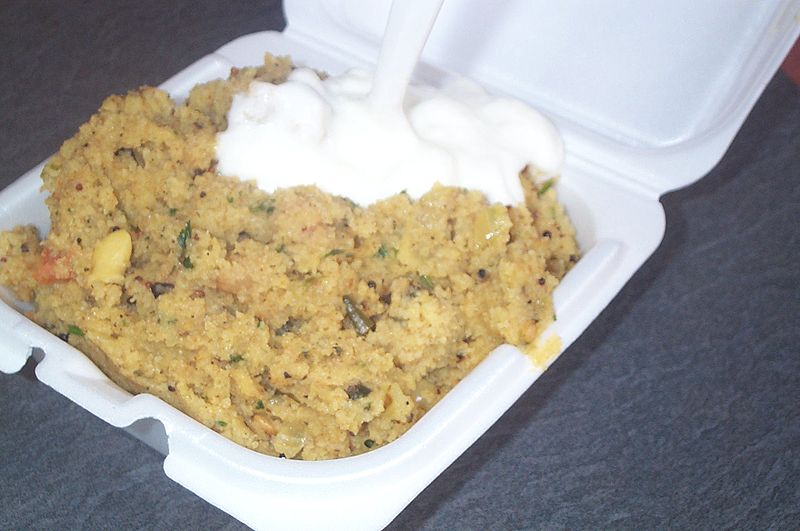
credit: stu_spivack
Okay, so my list of "minimum" ingredients may sound long and not quite that simple, but just the mere mention of the dish used to (and, okay, until fairly recently) immediately get my eyes rolling. It was a few notches below one of my other least favorites, Raisin Bran. (I abhor raisins.) Given the choice (which happened on occasion), I’d go hungry before digging into a piping hot bowl of fresh-made upma.

Apparently, I was the only one. Upma is generally considered "peasant food," with some foodies comparing it to “fertilizer.” It’s one of the few foods pious Hindus are allowed to eat when they’re fasting (albeit without the onions and garlic, which according to Ayurvedic belief are considered to be “hot” [garam] flavors that induce excessive behaviors). Add to that the old adage about Chinese food—no matter how much upma I ate, I was almost always scrounging for a snack to fill me up soon after.

I did eventually acquire a taste for it a couple years ago when I discovered "Mysore upma," a variation on the aforementioned basic recipe. The trick is to triple the proportion of water to semolina rather than simply doubling it, the the traditional way. The result is a moist, flavorful, and more filling dish than the dry, traditional version that somehow doesn't properly absorb the flavors of all those ingredients.

In any case, I knew few people who'd ever tried upma and even fewer who talked about it. So I had to do a double take when I saw it mentioned on the front page of a major American newspaper. Maybe a triple take.

Not only had upma made the mainstream media but, in order of stunning phrases strung together in the same sentence, 1) a New York chef 2) won $100,000 3) in a cooking contest 4) on Bravo’s Top Chef Masters, 5) a popular American reality show.

Excuse the italics, but it doesn’t get any weirder than that.

I hadn’t forgotten this big news on upma but neither had I registered the name of the prize-winning chef until a year later when he happened to be one of the featured speakers at a Konkani convention I'd attended in New Jersey. It was a bit of a surprise that the famous New York chef who won the Bravo show making, of all things, upma is, yes, Konkani. (Only reconfirming a friend’s assertion that we Konkanis are pretty into ourselves. Except now that “we” won a contest for making upma, I don’t see why we can’t toot our own horn.)

Floyd Cardoz, a Catholic Konkani who grew up in Goa and Mumbai, earned his undergrad degree in biochemistry before studying the culinary arts in Switzerland, working at a world-class restaurant in New York, and eventually opening his own restaurant, Tabla, in 1998. That celebrated venue has since closed, but Cardoz has two new restaurants—North End Grill (a traditional American bar and grill) and El Verano Taquería (a modern-day taco stand, with three locations in the Big Apple). He's also launched a line of gourmet “convenience” foods and written a popular fusion cookbook, generously borrowing flavors from his childhood in both Goa and Mumbai. All of these experiences have resulted in a culinary adventure, his own signature pairings of diverse ingredients such as morels and chilies, figs and cilantro-mint chutney, french fries and mango powder (amchur), scallops and fennel seeds, duck and tamarind. Speaking of which, ever heard of a tamarind margarita? That was one of the recipes he featured on Top Chef Masters.

Fronting his two main courses of rice-crusted snapper in a broth flavored with coriander and fennel and his rendition of a Malaysian beef stew, Cardoz calls his headline-grabbing twist on the old breakfast porridge an “upma polenta,” infused with coconut milk and (gasp) chicken broth, and topped with a melange of exotic wild mushrooms glazed in port wine. The result has been a surprising burst of interest in upma, even all over India, where upma Internet recipe searches have surged, customers at upscale restaurants are requesting the dish, and chefs are creating all kinds of new upma concoctions, including those with such non-traditional ingredients as chicken and seafood.

Following is the three-course meal, with links to the recipes, which won Cardoz the Bravo show’s ultimate prize award of $100,000 (all of which he contributed to charity, by the way):


3rd Course—Rendang 2 Ways: Oxtail & Short Ribs Tapioca Pilaf with Diced Potato & Peanuts

Tuesday, October 23, 2012

The Reluctant Matchmaker—A Book Review


By Alli Sinclair

I love reading books written by Indian writers as I find the prose, culture and the intricacies between the character’s relationships captivating. When Supriya suggested I give one of Shobhan Bantwal’s books a try, I jumped at the chance. Shobhan has written six women’s fiction novels that cover the issues affecting Indian women living in India and the United States.

I chose THE RELUCTANT MATCHMAKER, Shobhan's latest "Bollywood in a book," as its premise intrigued me instantly. Set in America, Meena Shenoy is a single, thirty-one-year old who works in PR for an Indian-run technology company. Even though she’s barely five-foot tall, Meena literally falls for her boss, Prajay Nayak, who towers over everyone. When he asks to meet her privately, she thinks he’ll confess his undying feelings for her. Instead, he wants to enlist her excellent PR skills and act as his marriage consultant to find him a bride who is no less than six-feet tall.

Reluctantly, Meena embarks on this project, all the while battling her romantic feelings for the man who is intent on finding an “Amazon in a sari.” Woven in with Meena’s story, are a wonderful bunch of characters, including Meena’s elderly Aunt Akka who drinks booze, eats meat, and decades ago shunned tradition and married for love. Akka is Meena’s voice of reason and pushes Meena to follow her heart and not let anything, including height, get in the way of her dreams.

Meena’s brother, Maneel, has his own challenge when he falls in love with Naseem, a successful woman who happens to be a Muslim. Meena’s Hindu parents have a hard time accepting the relationship.

Meena’s parents are in favor of a traditionally arranged marriage for their daughter who is about to be put on the shelf, but Meena is determined to find her own man. She dates a couple of men and tries to fall for one of them, but she can’t shake her obsession over her boss, Prajay, whom she thinks views her as his petite and fragile marriage consultant.

I’ll leave it there, as I don’t want to spoil this fabulous read. Shobhan does a wonderful job of addressing karma and whether it’s possible to change one’s destiny through Meena attempting to mold her future but she’s constantly challenged by the actions of others.

The main characters in the book are of Konkani descent, and I’ve yet to find other fiction written about these Indo-Aryan people. The author, Shobhan Bantwal, is Konkani as well, and this is the first book she’s written focusing on Konkani characters. Her knowledge about their views on marriage and tradition gives an interesting insight into the Konkani culture.

THE RELUCTANT MATCHMAKER is a fun read while also addressing issues affecting people torn between traditions from their old country and adapting to the lifestyle in their new land. It’s a fine balance and can easily send one toppling head first into either camp. This dilemma, of course, is handled wonderfully in THE RELUCTANT MATCHMAKER while taking the reader on an exciting journey with the main character, Meena, and her amusing family. This book is perfect for readers who like a mix of culture, traditions, and romance. I’m looking forward to reading more of Shobhan Bantwal’s books!

Wednesday, July 4, 2012

Worlds Within Worlds


By Supriya Savkoor

Just back from a weekend trip that was unexpectedly unique and  one I’m certain to remember for years to come.

My aunt, a self-published author visiting the States from India, invited me to join her at a conference in New Jersey this past weekend. She tempted me by saying she would be teaching a creative writing workshop for kids as well as speaking on an author panel to promote her book. Both events cinched the deal—I got myself registered, and we coordinated where to meet and where to stay.

But the weekend did not get off to a great start. It was a scorcher, first of all. I started my drive from Northern Virginia in 112-degree weather. What should have been a 3-hour drive turned into a more than 6-hour long haul. Along the way, the occasional broken-down car lined the shoulder of the highway. The temperature dropped steadily till after dark, my A/C finally started working. By the time the outside temp reached 92, it started to feel chilly inside the car. I was sleepy, trying to think about which of my previous vacations I could write about for today’s blog. Meanwhile, cars with clever vanity plates such as M3RLOT, BKEEPNG, HIP1 CHIK, and U R LVD, whizzed past me, making me wonder instead about the inner lives of their passengers and the more interesting stories they could tell rather than those of my old vacations.

I reached Edison late Friday night, and by Saturday morning, I found myself at the opening ceremony of the convention. You probably guessed I was attending a writers’ conference, but no. It was a conference dedicated to all things Konkani—Konkani being the linguistic and cultural group from which I hail, and which I’ve written about in this space often. Some 1,800 attendees registered, flying in from nearly every continent. The organizers billed it as the largest gathering of Konkanis outside India. I didn’t think they could surprise me, but the event was so beautifully organized, it left me, and countless others, in awe. In addition to amazing entertainment and delicious food, the convention was filled with presentations and workshops led by noted Konkani luminaries—film directors, actors, authors, philanthropists, musicians, even a famous Top Chef, who judged a terrific recipe contest. (I must get those fusion recipes for tamarind-braised ribs with kale, avocado smoothies, and jackfruit kebabs.) Another contest, Konkanis Got Talent, was filled with some really impressive talent, some of whom I feel certain to hear more about in the years to come.

Then there were the dozens and dozens of instances of running into friends and family I hadn’t seen in eons, in some cases up to 25 or 30 years. I even ran into a woman with whom I’d had a chance meeting on a train in India in the late ‘80s. (Definitely a story for another day!) There were so many such incidents, in fact, that the weekend left me in awe about … well, so many things. The power of culture and community, of course. The passage of time. The magic of coincidence. Different moments of my life remembered and appreciated. History, my own, and that of this group of diverse people from the world over.

The event’s chief guest was someone I hadn’t heard of before, but who brought the crowd to their feet with his inspiring opening speech. You can read about T.V. Mohandas Pai here, but in addition to all the other amazing things you might learn about him, consider this: He’s a top executive who voluntarily donates 40 percent of his salary to charity. What good is money if you can’t use it to help others, right? Filled me with pride.

I can’t quite remember the number he cited of how many Konkanis there are, something like 2.2 million or maybe it was 2.6 million. Either way, as he rightly noted, it’s hardly a blip when you consider the population of India as a whole is 1.2 billion. And again, it kind of got me thinking about those cars I’d passed on the drive up, wondering about the lives of people I haven’t met, all the untold stories waiting to unfold. Most folks I meet, even Indians, haven’t heard of Konkani, and yet here’s this rich, complex community, represented in nearly every country, every religion, every profession. Not exactly a hidden community but certainly a subculture of sorts. 

And yet someone passing the convention center might think what was going on inside was just another Indian festival in the New Jersey suburbs, right? Not hardly.

Wednesday, March 7, 2012

Little Red Seeds, A Little Red in the Face, and the Well-Read Wiki Reader

By Supriya Savkoor


Before I launch into our topic of the week, a little throat clearing.

I’ve been just the teeniest bit embarrassed about my post from a couple of weeks ago, the one where I researched my ancestors through antiquity then shared it with all of you in a loosely packaged, thesis-length blog post. (Remember the part about my Australoid tribal ancestors from pre-historic times? Groan. Yes, I really did cover that, though I probably owe you some money if you made it that far. At least a couple friends thought so, though none of them passed my pop quiz.)

The reason for my over-enthusiasm about the whole topic was that I’d always thought of myself as just a boring purebred, growing up listening to friends recount what percentage blood they had that was Dutch, Cherokee, Spanish, Irish, Czech, you name it. I remember asking my dad after school one day if there was even the slightest possibility we might have a slightly more exotic lineage than just plain old Konkani. No, he said a little too quickly. Probably seeing the dejection on my face, he added, “we might be a little tiny bit Portuguese. But no. Probably not even that.” After all, how long could he pull that one off?

So when recently one of our topics was word migrations, I thought tracing the origin of my Saraswat roots might give me just a little something to write about, a paragraph or two, if that. By the time I finished my Internet search, unraveling those many disparate but apparently connected threads to my roots, I had one large, messy heap of cross-cultural factoids that left me in awe of my genetic forebears, who, if not mixed blood, at least crossed paths with Aryans, Dravidians, Sumerians, Ethiopians, Arabs, Persians, and who knows what other great, ancient people. If only Wiki and Google had been around when I was a kid, right?

And here’s the other thing: during that brief period of intense research and wonder, I learned another little tidbit about my ancestory that relates to this week’s topic on inventions. (You see, I was not digressing! Not this time.)

Years ago, my mother in-law had brought us a little game from India called gudfale (pronounced “good-fullee,” with a short U sound). She’d bought it from a roadside vendor when she was a kid, “paid only four annas” for it, or about the Indian equivalent of a quarter. I’d visited India so many times as a kid, I couldn’t believe I hadn’t come across the game yet, so I kept pressing her with questions about it. I think that’s when she herself made the realization that while it had been a common pastime in the region on India’s western coast, known as the Konkan Coast, where she grew up, she too hadn’t seen the game elsewhere in the country.

You can probably tell from the photo why it was love at first sight for me. Carved out of a single slab of rich, dark wood, it contains two rows of little cup-like openings. The game itself is pretty simple. Two players distribute an equal number of shiny red seeds in each of the openings, then take turns moving a pile on their side of the board to each consecutive cup around the board until the reach an empty cup. Once they get to that empty spot, they skip it and collect whatever seeds lie in the next cup holding seeds. They keep going, round and round, until one player runs out of seeds. Whoever wins the most, wins the game.

Believe me, it’s much simpler than it sounds. But it wasn’t the play that fascinated me as much as the simple beauty of the wood itself, not to mention those bright, shiny red seeds that I’d sort of remembered as tamarind or pomegranate. I really can’t remember what fruit she’d said they came from, really, only that their glossy rich color appeared naturally. I remember this because I found it so hard to believe those seeds weren’t painted. Now I know she was right. Thanks again, Wiki.)

But be forewarned: I have my next thesis topic. The reason my mother in-law only found gudfale on India’s western coast and not the rest of India is probably because of the significant influx of Ethiopians known as Siddhis who’d emigrated there between the 16th and 19th centuries. Siddhi is a term of respect that came from either “sayyid” or “saydi” meaning master. The Siddhis likely brought mancala, which they called gebeta, to India with them. Perhaps you’ve heard of the African game “mancala”? Same thing. Be prepared to ooh and aah when you take a look at this picture from Africa.


It’s a sculpture of two Lobi children from Burkina Faso, Côte d'Ivoire, or Ghana playing mancala, but scholars believe the game originated in Ethiopia itself back in the 6th or 7th century. Here's proof from Aksum, Ethiopia, in one of the earliest known archaeological findings.


Since then the game has spread all over the world – the Middle East, Europe, other parts of Asia, even farther south on the Indian coast. And it goes by many names. But isn’t it a wonder that the Ethiopians could have brought it directly with them to this thin mostly rural strip in India where it’s still played centuries later?

And the game continues to move through cultures and generations. 

Coincidentally, in just the past few weeks, my nine-year-old daughter started learning how to play mancala at school. Her elementary school web site includes hot links to the history of the game, strategies for playing, and all kinds of interesting pictures such as this one taken in a Sri Lankan hotel lobby.


And my daughter? She prefers the following version: http://www.mathplayground.com/mancala.html

Wednesday, February 15, 2012

No, Really, Who Am I?

Someone recently asked whether my family is north or south Indian, and the question gave me serious pause. I know, it should be a fairly straightforward question for anyone to answer, yet I’m embarrassed to admit that I couldn’t do it. Even after a bit of research, I’m still not quite certain. Yes, I see you shaking your head and muttering “no way.” And yet…

Part of the problem is that both my parents are from Bombay, born and raised. Bombay or Mumbai, as it's now called is a little like New York. Once you move there, it’s hard to remember anywhere you’d been before. (That dig is specifically directed at my New York friends, who’ve fallen off the map, so to speak.)

And yes, at least a couple of my grandparents and possibly most of my great grandparents were born in the south Indian state of Karnataka. Some of my ancestors even took their surnames from the tiny villages in Karnataka where they lived. That makes us south Indian, right? Maybe.

The distribution of Konkani speakers along India's
southwestern coast. (Photo by ImperiumCaelestis)
The predominant language spoken in Karnataka today is Kannada, a Dravidic language like the other main south Indian languages such as Telugu, Malayalam, and Tamil. Dravidians belong to one of two major civilizations that have their roots in ancient India, the Aryans being the other and from which north Indians and Pakistanis have descended. Scholars believe the Indian subcontinent was entirely Dravidian until the Aryans migrated south from Central Asia and possibly the Caucasus (southern Russia).

The two traditions are as different as night and day. The languages are completely different, though today, they reflect slight influences on one another. The Dravidic languages have curly alphabets that look and sound different from north Indian languages, which use the more linear devnagri script. Aryans are typically fairer, Dravidians darker. The two have different accents, and many would say, very different cultures, even histories. Though India is probably one of the most successful melting pots you'll find, as with any large, diverse culture, biases and discrimination exist between these groups. Not as a rule, just on occasion.

Perhaps I’m just reluctant to choose sides, you’re wondering? It’s more complicated. My family speaks Konkani, which happens to sound a lot like Marathi, the main language spoken in Maharashtra, of which Mumbai is the capital. Konkani also shares a lot of etymology from Hindi, a north Indian language. Without much effort, I can understand a good bit of both languages (though more Marathi than Hindi), whereas I cannot understand a word of South Indian languages. I've heard quite a bit of Kannada spoken around my in-laws’ home in Bangalore but still can't understand more than a handful of words. (They, too, are Konkani, yet my father in-law can’t speak a word of it. Or maybe won’t.)

A NASA satellite image shows the location of
the ancient Saraswati River, which has since dried up.
It’s also been established that the Konkani-speaking community from which I hail, known as the Saraswats, descended from one of the five Hindu Brahmin communities that once lived on the banks of the ancient Saraswati River. Many subcommunities hail from these original Saraswats, including the Kashmiri Saraswat Brahmins, of which former prime minister Indira Gandhi was a notable member. In fact, many people from her community use the surnames of “bhat” or “pandit,” meaning priest and religious scholar. Gandhi’s father, Jawaharlal Nehru, whom I wrote about last week, was widely called Panditji, the “ji” added as a term of honor. Many Konkani-speaking Saraswats from Karnataka are descended from pandits as well, from even just a few generations back, before their own kids started moving away to study, work, and eventually take up other occupations in big cities and abroad.

Last month, after being asked about my northern vs. southern roots and stumbling over my response, I did a little research. That is, I turned to Wikipedia, where I learned that my community likely did descend from the original Kashmiri pandits – though not conclusively. (Damn you, Wiki!)

I’d been hearing bits and pieces of this theory for years, even had an American college professor who wrote a book on the topic, so it was interesting to gather more details. Beginning in the early 13th century, forced conversion to Islam had begun in Kashmir, driven in large part by a Mughal general from Turkmenistan. Between 1389 and 1413, religious persecution of Hindus was at its peak under a sultan who at the time ruled Kashmir, leading many Saraswats to head southwest to Goa (just a bit north of Karnataka), drawn there because of the fertile land along the Arabian Sea and the religious tolerance under its local (Dravidian) kingdoms. 

On their way south, the Saraswats passed through Gujarat, which may explain why Konkani-speaking Saraswats share some vocabulary with Gujarati, words even Marathi and Hindi, with their closer linguistic association to Gujarati, don’t use. (Hard to otherwise explain this fact.)
Cover page of the 1622 book,
Doutrina Christam em Lingoa
Bramana Canarim
("Christian
Doctrines in the Canarese Brahmin
Language"), by Fr. Thomas Stephens,
a Jesuit missionary priest in Goa

Before the Saraswats arrived in Goa, the local form of Konkani had already been influenced by other cultures, for example, by ancient Sumerians who had settled there. Goa had long been a major trade center with the Arabs and Persians as well, so many Arab and Persian words infiltrated into Konkani – such as dhukan for “shop,” fakt for “only,” and karz for “debt.” A few centuries after the Saraswats arrived and adopted Konkani as their new language, Portuguese traders followed by Christian missionaries landed in Goa. From the 16th century until the early 19th century, the Goa Inquisition resulted in many forced conversions, this time to Christianity. To avoid persecution and/or losing their land, a great number of Saraswats converted to Catholicism and even today are known as “Brahmin Catholics.” Goa still retains this largely Christian, Portuguese-influenced Konkani culture and language.

Meanwhile, a smaller group of Saraswats moved farther south, into the small villages and towns of Karnataka. Some moved farther still, into Kerala. In both Karnataka and Kerala, they were able to practice their religion, build temples, buy land, and hold government jobs. Today along this coastal stretch, you’ll find not just Saraswats, but Konkanis of all religions and dialects, too numerous to count. Konkani Muslims in Karnataka, for example, are descended from the intermarriage between the locals and Arab seafarers as well as through conversions. The sailor-warriors from Ethiopia, known as Siddhis, also adopted the language and planted roots in the area. (Yes, there are black people in India. And they weren't slaves.)

When Bombay became a boom town in the early 19th century, a great many Konkani-speaking Saraswats – no doubt, drawing from their adventurous, nomadic roots – migrated there, so much so, that many families, such as mine, lost most of their connection with the south, while others, such as my husband’s family, retained it. Though exact numbers are hard to come by, it’s possible that today as many Konkani-speaking Saraswats live outside of India as within it.

A few parts of this history still aren't clear: how and why did we pick up the Konkani language? It appears that Konkani existed in the south long before the Saraswats’ exodus from Kashmir. The earliest-known proof of its existence dates to about the 2nd century A.D., and Konkani was already spoken on the Konkan Coast, from Goa to Kerala. But that fact only raises more questions – if Konkani was already spoken in that part of the world, what did the Saraswats speak before they moved there? And if we adopted a language that already existed in the area, could we also have been absorbed into its culture through the mixing of bloodlines? Maybe we have both north and south Indian blood? 

And why did the Saraswars adopt Konkani, of all things, and not one of the more widely spoken (read: more useful) majority languages, one with a real script?

A map adapted from A Historical Atlas of South
Asia
, Oxford University Press (1992), lists Konkani
as an Indo-Aryan language. (Image by BishkekRock)

The origin of the Konkani language is a puzzle anthropologists are still figuring out as well. It appears to be an Indo-Aryan language, related more to Sanskrit than to the Dravidic languages of the south. One article I found says these Saraswats spoke Sanskrit in public and invented a simplified version, Brahmani, that they spoke at home. Brahmani may have formed a sort of grassroots version of Konkani. A study by the Indian Anthropological Society found that some Konkani speakers (not the Saraswats) are descended from Australoid tribes that came to India from the Mediterranean in pre-historic times, spoke early Dravidian languages, and migrated to north India! (Then moved back with the Saraswats? If so, no kidding about our nomadic spirit. No wonder I'm so antsy.) 

Even the origin of the word “Konkani” is disputed. It sounds a bit like the word Kannada, but it could also have been derived from the Persian (Aryan) word kinara, meaning “the language of the coast." The anthropologists who conducted the study conclude it could just be a language born of the confluence of Indo-Aryan dialects that absorbed some Dravidic characteristics. Either way, Konkani has the structure and syntax of an Aryan language and the grammar of a Dravidic one. 

All that to say that the Saraswats who left Kashmir for Karnataka probably took along their own dialect (possibly Brahmani), borrowed some useful Gujarati words along the way, and melded it all with a Dravidic form of Konkani, which in turn borrowed from the Persian and Arabic. Sounds like a real stretch, but if it's true, it's a pretty astounding amalgamation of cultures and languages.

Either way, I’ll just have to change the subject next time someone asks me that question, don't you think?

Wednesday, February 16, 2011

Konkani Cabaret

Photo courtesy Sanferd Menino Rodrigues
If you’ve been following my posts so far, you probably know my linguistic roots lie in a small community off the southwestern coast of India known as Konkan. (Konkani is the name of the community as well as the language.) You may also know I’m a complete dud with languages, so it may seem odd that this week I’m sharing some fun stuff from a Konkani dialect I can’t understand a word of.
 
First, a little explanation. There are at least a dozen regional dialects of Konkani that sound very different from one another, sometimes so much so that it’s hard to understand how they’re related. The same is true of the various subcultures themselves. My family is Brahmin Hindu, which means we hail from the priestly class. We have very conservative, almost monastic roots. Our forefathers were religious scholars. Our meals are supposed to be pure vegetarian (some Brahmins won’t eat onions or garlic because they are considered tamasic, meaning that they could generate worldly feelings). Our traditional weddings are more ritualistic, more stoic than other Indian ones. Of course, all this has changed a lot over the generations, but it’s still a steep contrast from, say, the Goan Konkanis.

Goans like to party. Okay, that’s probably a generalization but one that fits my skewed impression of their Konkani culture compared to ours. Goa is India’s smallest state (and its most affluent), a gorgeous, tropical island with amazing beaches and resorts, one that draws tourists the world over. It has its own unique, vibrant culture, in part because it was never a part of the British Raj. Instead, it was a Portuguese territory until 1961. As such, its dialect of Konkani is peppered with Portuguese, and most Goans are Catholic. On visits to India growing up, I always found Goans most fascinating. I’d never met Indians who’d attended church so right off the bat, that was different. They had names I didn’t know Indians had (mostly biblical, such as Peter and Mary, or else Portuguese ones, like Zabel and Pedro). I’d never seen either of my grandmothers wear anything but saris, yet in India, even elderly Goan women let their legs show, wearing trendy dresses and heels.

Then there’s Goan music. On visits to India, I mostly heard (Hindi) Bollywood film songs or religious ones (Urdu classical or Marathi bhajans). That I know of, only the Goans sang in Konkani, or for that matter, in English. Back then, Goan songs sounded like India’s version of island music, with acoustic guitars and maybe a few mariachis in the background. Being from a linguistic culture that had no script and so no books or media in our language or about us, it was exciting to me that we had our own music, even if I couldn’t understand a word of it. Plus I was amazed that something so exotic, so provocative could really be Konkani.

Lorna Cordeiro is a popular Goan jazz singer, whom fans know simply as Lorna. Her popularity peaked in the 1970s, when she sang in the Chris Perry Band, crooning English and Konkani songs in nightclubs across India, mostly Mumbai. (Chris Perry was a well-known Konkani musician, by the way.) Chris played the sax, and Lorna wore tight, strapless dresses, looking and sounding a little like an Indian Billie Holliday. Check out one of Lorna’s most popular songs, Bebdo (thank goodness for the subtitles):


Nike borrowed the music from Bebdo for one of its international ads to promote its line of cricket gear. This version of the song, Rav Patrao Rav, is sung by Ella Castellino. In the video above, the endnotes say that Lorna is really the voice behind Ella Castellino, and it provides a translation for the Nike commercial that follows (and which happens to feature cameos of two Indian cricketers):


Of course, these days, reams of Konkani songs of all sorts—rock, pop, rap—abound online but since I’m kind of on a Lorna kick, I’ll leave you with a couple more links.

Here’s one of her singing Bebdo in recent years: 

Another one of her classic Konkani tunes, Red Rose
http://www.youtube.com/watch?v=pDUzM0n48Ak&feature=related 

And lastly, a video that’s a little over three minutes long. Pace yourself—this is a slow song, and there’s an interlude of dialogue from a Konkani film that’s not very exciting (or well acted) but it's different: http://www.youtube.com/watch?v=vc_4Qo0F374&feature=related 

Do you have any music suggestions to share that could expose us to an unfamiliar culture?

Wednesday, December 15, 2010

Secret Language Decoded

My daughters, ages five and eight, often speak in a secret language only the two of them know so we grownups won’t understand what mischief they’re up to. I don’t have permission to tell you its name (that’s classified), but it’s a real language. So they say. When we try to isolate them individually and see if the terminology really matches up (it never does), they insist that there are just too many dialects for them to keep track of. Yeah. What. Ever.

It’s okay. My husband and I have our own secret language. We use it in front of the kids and most everyone else we know outside of our extended family. But ours is a real spoken language called Konkani (kōnk-er-nee"). It’s also the name of our community, which, funny, but has many nuanced dialects that sometimes don’t sound much like each other. None of them has an actual script, although some borrow the script of whatever local, majority languages they write in.

Now, if you’ve ever been in a public place where people are speaking a foreign language and you’re dying to know what they’re saying, you’ll hate this. But we can speak Konkani, our secret language, even in front of most Indian people without them quite knowing what we’re talking about. That’s because Konkani overlaps only a little here and there with other major Indian languages. Talk about secret. I can barely even understand other Konkani dialects. It works in reverse too, unfortunately. I can’t watch a Bollywood movie without subtitles, for example.

Surely I’ll be excommunicated for this, but what follows are some of my favorite Konkani words for which there are really no proper English translations:

Saadhook: I love this word, and others like it, even though I can think of very few instances where I could use them. Sadhook is the word for how my father and father in-law are related to each other. Can you think of a single word to describe that relationship in any other language? I don’t know of any, yet Konkani has a many such linguistic brainteasers. We have multiple words for sister in-law, depending on whether it’s your brother’s wife or sister’s husband’s sister (and so on). And for female cousin, be it your mother’s sister’s daughter, mother’s brother’s daughter, father’s sister’s daughter, or father’s brother’s daughter. Same thing for male cousin. Talk about precise, right? We don’t have a script, but we have eight different words to explain our first cousins.

Ushtaa: The meaning and sound of this word are both pretty lowbrow, so if any word will have me excommunicated, it’s probably this one. Ushtaa means saliva but also, and here’s the fun part, the word for any object (a glass or spoon, for example) that one person’s eaten or drunk from so that another person knows they’re not the first to eat or drink from it. It does not mean contagious or germy, only previously tasted … or something like that. I don’t know any translation for this concept that doesn’t require more than this one word, so talk about useful. My kids use “ushtaa” all the time (especially when someone’s sick), but since we speak English almost exclusively at home, my five-year-old still doesn’t believe this word is not English. Uh-oh.

Ul-sheekh: Another embarrassing word. In fact, it means something like embarrassing, only far, far worse. Awfully humiliating. To the nth degree. It’s very extreme and, as it turns out, quite handy.

Dristhi: This unique word has a universal meaning and plenty of counterparts, in almost every language and culture. In Hindi, it’s nazar. In Bengali, nojor. In Farsi, it’s cheshme bad or nazar zadan (notice the similarity with Hindi). In Hebrew, eyna hara. In Italian, malocchio. In Spanish, mal de ojo or mirada torva. In English, it’s the evil eye or jinx. Dristhi keeps us cautious, modest, and ever-watchful. (Exactly why I shouldn’t be sharing these secrets. On the Internet.)

So there you have it – Konkani secrets unveiled. Now it’s your turn. What interesting, unusual words can you share with us? Don’t worry, your secret’s safe with us.