Monday, June 25, 2012

Poet in the Dawn of the Cold Season


Forugh Farrokhzad
By Heidi Noroozy

When a member of my Iranian family reaches a crossroads in life and feels in need of advice, they turn to the Persian poet, Hafez. They engage in a ritual called fal-e Hafez, where you open a book of Hafez poems to a random location and seek guidance in the wisdom you find between the lines. After all, Hafez, Rumi, Ferdowsi, and the rest of Iran’s pantheon of Persian poets occupy a special place in the Iranian soul.

As an American, I’m far less adept at drawing wisdom from between the lines of 14th century Persian verse, yet I still believe that poetry is a great source of inspiration. Instead of seeking guidance from Hafez or Rumi, I’m more likely to turn to another, more contemporary Persian poet: Forugh Farrokhzad.

Born in 1935 in Tehran, Forugh spent much of her short life breaking down the taboos and social conventions of her male-dominated world. At sixteen, she married a cousin 15 years her senior and lived for the next few years in Ahvaz, a provincial city near the border with Iraq. It was a time of great social change in Iran. The shah had banned the veil in 1936, and many women, including Forugh, were embracing their new found liberty. But not everyone was ready to accept women entering public life.

Especially not a strong-minded female poet whose work came straight from the heart and explored deeply personal themes of love, sexuality, and the struggle for balance between career and family life. Rumors of adulterous affairs followed and crushed Forugh’s beleaguered marriage. After her divorce, she lost custody of her young son, who was placed in the care of his father’s family.

Between 1955 and 1967, Forugh published four poetry collections. The literary journals recognized her great talent and solicited her work, but Tehran’s literati rejected her. They called her sha-ereh (poetess), a term that denigrated her ability to become a serious artist and implied that, as a woman, she could never be anything more than a wannabe poet. Stories of sexual encounters, real or imagined, overshadowed her literary accomplishments.

In her early work, Forugh wrote frankly about her frustrations as a woman trying to make her way in a man’s world and finding the only acceptable role as that of wife and mother. In Captive, she writes:

It’s you I want, yet I know why
I could never hold you to my heart’s content,
for you’re the bright and cloudless sky
and I am a bird captive in a cage.*

In other poems, she writes candidly about sexuality from a woman’s perspective, sometimes describing very specific experiences with lovers, as in the poem, Sin, which was considered quite scandalous at the time of its publication:

I have sinned a rapturous sin
in a warm enflamed embrace,
sinned in a pair of vindictive arms,
arms violent and ablaze.*

Although Forugh explored themes based on the female experience, she didn’t consider herself a feminist poet. She dismissed the significance of her gender and saw her role as an observer of humanity and society who happened to be born a woman. In her later work, her themes grew more complex and broadened to include injustice, social alienation, and religious intolerance.

Forugh Farrokhzad's grave in the
Zahir-o-Dowleh Cemetery, Tehran
In 1967, at the age of 32, Forugh Farrokhzad died in a car accident when she tried to avoid a school bus and crashed into a wall. She was buried in Tehran on a snowy February day, her funeral well attended by the literary luminaries who’d called her a mere “poetess” just ten years before. Her final collection, Let’s Believe in the Dawn of the Cold Season, was published posthumously.

Reading Forugh’s poetry is like spending an evening in deep discussion with a dear friend over a bottle of wine. I feel like I’ve gazed into the depths of her soul and seen a reflection of myself there. But her life is also a source of inspiration. She’s a woman who followed her heart despite constant rejection—and her persistence paid off in the end. Today, she’s considered one of Iran’s greatest poets, an artist who has earned every right to sit at the table with the likes of Hafez, Rumi, and Ferdowsi.

To read more of her work, check out these English versions of two poems (Sin and Reborn), translated by the Iranian-American poet, Sholeh Wolpé.

*Both excerpts are from Sin: Selected Poems of Forugh Farrokhzad, translated by Sholeh Wolpé.

Thursday, June 21, 2012

The Cheese is Dead

By Edith McClintock

Satirical cartoon from 1885 about the
selling of American symbols.
Growing up I never considered myself particularly American. I’d spent my early years on a commune in Tennessee and then moved to Miami, a city where the majority of residents are born outside the country. It wasn’t until my twenties, when I moved abroad, that I realized I was undeniably, culturally American. But then most of my life story (utopia, immigration) had actually been very much on point for the cultural archetype of the American Dream.

But what does this mean for advertising and marketing you might ask?

The Dream is the subconscious “cultural code” for America, similar to Joseph Campbell’s idea of universal archetypes within the world’s myths. This is according to a book called the Culture Code by a French man, Clotaire Rapaille. Rapaille researches and uses the unconscious meanings we apply to certain words, our emotional connection to things, to relationships, and uses them to sell us products, experiences, and even people. The idea of the American Dream might seem obvious, but then so too does the connection between marketing and emotions. And yet it works, even when we know.

The culture we are raised in absolutely affects how we act and react to the world. But more important for the transnational corporations that sell the world, it matters in terms of what we buy, why we buy, and where we buy. Even how we vote. If we vote.

According to Rapaille, most of our unconscious emotional connections are formed by the age of seven, which means there are probably many common American cultural codes to which I can’t relate. Food is one. He tells the story of the difference between cheese in France and America. In the U.S. cheese is dead. In France it’s alive. As these are the culture codes for cheese, according to him anyway, it means Americans want their cheese pasteurized and wrapped and kept cold while the French want their cheese unpasteurized and kept in a protective container in the open air.

So what happens if you’re raised vegan, like me? Do I have no emotional connection to cheese? Am I immune to cheesy advertisements? Nope. Marketers are experts at selling their goods or services to cultures with no emotional connection to a product. They simply create one, sometimes over generations.

Nestlé might have paved the
instant coffee way, but
Starbucks Via is coming for them.
Rapaille gives the example of Nestlé instant coffee in Japan. The Japanese prefer tea and in the 1970s did not have a culture of drinking coffee, much less instant coffee. So Nestlé created a connection in the culture by starting with kids, selling them coffee flavored candy without caffeine in the hope they would grow into their instant coffee. And not just in Japan. Instant coffee is now ubiquitous throughout the world—last year when I was in Georgia, Nestlé commercials aired non-stop, nearly convincing me instant coffee doesn’t taste like plastic.

What he doesn’t mention is that in the 1970s Nestlé was also promoting the use of infant formula to mothers across the world, including in many of the poorest countries. In that too they were successful, even in convincing poverty-stricken mothers to defy logic and pay to buy formula rather than use their healthier, free breast milk.

My parents, in their youthful wisdom, didn’t allow me to watch commercials on television when I was young, and I still don’t when I have a choice. I flip the channel or turn off the sound when a commercial comes on, but more because they annoy me than any hope of escaping advertisements. Marketers have moved beyond mere commercials and billboards or radio ads to using product placement in movies, on sports teams or arenas, through viral videos, Pinterest, Facebook tagging or liking of products, and always chasing the cool, the community influencers.

My three-year-old nephew, who has never seen a traditional commercial in his life, is already inundated in marketing because he has seen Disney and Pixar movies, even Sesame Street. And these are as much commercials as anything else. He recently told me he wanted to see the boy we were reading about in a book “up on the TV”, that he wanted the car shown in the picture book. Unfortunately for him, it was a rare book with no additional commercial tie-ins.

The aim is always to make us buy more, but the most successful marketers do it in a way that we think it is our own idea. Our own real desire.

It doesn’t stop with buying things. Marketing is also used to influence the way we vote, although that too is connected to what we buy. As just one example, in 2010, General Electric (G.E.), the world’s third largest public company, a company that made $5 billion from U.S. operations selling movies and television shows and light bulbs, etc, paid $0 in taxes according to The New York Times. That doesn’t happen by accident. It comes from lobbying, supporting politicians, and getting them to pass beneficial tax laws.

Politicians too have much to sell, starting with themselves. This works for President Obama as his life story is the American Dream. Or so his books, titled Dreams from my Father and The Audacity of Hope: Thoughts on Reclaiming the American Dream seem to claim. His campaign taglines are Hope (2008) and Forward (2012). He’s saying Americans are optimistic, always looking to the future. Simple. Obvious. Right? It’s what we already believe. I bought it. I’ll do it again, too.

Mitt Romney’s book—as it seems all presidential aspirants in the U.S. must now have one—is titled: No Apology: The Case for American Greatness. What Romney leaves out is his own life story. Not his business background, but his religion, his family’s history as founders of the Mormon Church. In my view, it wouldn’t hurt him to talk about his religion as Mormons are nothing if not quintessentially, born and bred, utopian American Dreamers—and unlike those hippies, they’re clean-cut and polite.

Better yet, according to Rapaille, Americans are looking for a Moses symbol in their President—a rebellious leader who will lead them out of trouble. Well, we all know Obama was Moses in 2004, but did you know Moses visited and blessed Joseph Smith and all Mormons as leaders of America in 1863? I'm paraphrasing slightly, but I think Smith had a strong grasp of this concept of codes and unconscious emotional connections.

Romney’s campaign tagline is: “We have a moral responsibility not to spend more than we take in.” It’s a nice idea, but is it good marketing? It doesn’t seem to translate culturally in a place like Miami, which is flat and warm, yet the car of choice is a gigantic Cadillac Escalade that sells for over $63,000. I’ve spent a lot of time trying to convince Miamians they need to save energy, buy more efficient cars, walk to work, but to my everlasting regret it rarely works. (What does? Higher gas prices.)

The truth is most likely Romney’s campaign messaging is right on code. He’s simply selling to a segment of America with a very different cultural code than my own, a very different idea of what the American Dream means.

If you think you aren’t persuadable, that you know why you buy things, why you vote for one candidate over another, why you like a particular musician or book, watch these two Frontline specials on PBS: The Persuaders and the The Merchants of Cool. They’re available online. You might just change your mind. 

For more, visit my author website and/or personal blog, A Wandering Tale. Even better, order a copy of Monkey Love & Murder on AmazonBarnes & Noble, or the Book Depository (free shipping nearly anywhere in the world).

Wednesday, June 20, 2012

When Lettuce is Deadly and Milk Makes Paper


By Beth Green

No matter where I travel, I love taking pictures of signs, labels or T-shirts with silly translations and malapropisms.

And while I’ve seen some of these in English-speaking countries (The USA’s “slow children” road signs are a prime example of poorly used English, in my opinion), of course when things are translated from another language into English, the potential for snicker-worthy results is raised.

In China, most people you meet who are in their mid-30s or younger will have had some exposure to English in their schooling. Whether that experience went beyond learning the ABCs or not, everyone’s got some level of familiarity with it. Couple this with the craze for Western luxury items like iPhones, Louis Vuitton and, yes, McDonald’s, and you’ve got an instant way to make your product seem more appealing, exotic and valuable: splash the packaging with English words.

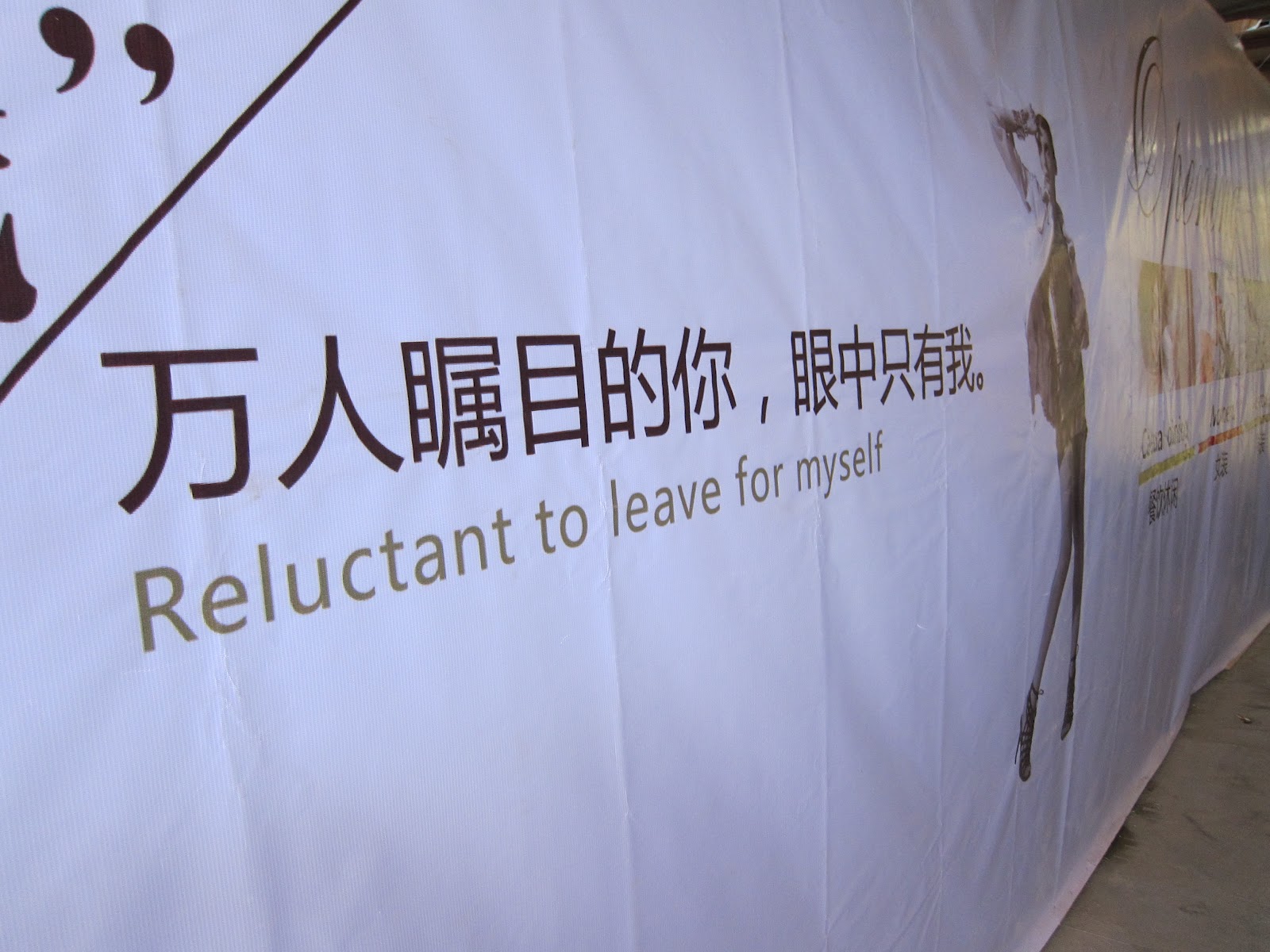
A new shopping mall (housing not only a McDonald’s but also a KFC, Burger King, Dairy Queen, Wal-Mart and Pizza Hut) recently opened a few blocks from my apartment. Intrigued by the progress, I walked by a few weeks before it was fully opened. The ongoing construction was discreetly screened from pedestrians by large canvasses bearing images of classy-looking people and slogans such as the following: “Reluctant to leave for myself.” Obviously, some designer picked words at random and put them on the banner to give it a little oomph. Too bad it’s nonsensical.

Reluctant to...what?
Perhaps my favorite example of a strange translation is this one, which I found at the local bulk foods supermarket. The label reads like a bizzaro newspaper headline:

That dastardly lettuce.
Other advertisements in China that use English may actually make their product sound not only silly, but also of poor quality. Consider the bus I saw completely covered with this slogan: OK Manly Banner. The best they could say about it was that it’s just OK?

Better than Not Very Manly, I guess.
Or this one, which I’m sure Pepsi can’t have been pleased about:

Perhaps "economical" would sound better? Nah.
This restaurant is also quite modest:

Want to go somewhere "nice" for dinner?
And this shop actually says that they are “no right, just suitable.”

Suitable, but not right?
I found this restaurant ad in Hong Kong downright unappetizing:

Guts for lunch?
Others are just curious…should I write on this or eat it?

I'd heard of onion-skin paper before, I guess...
Some slightly risque (or maybe dangerous?!):

At least they're small.
And still others, kind of sweet:

Me so happy too.
What examples of silly English have you found on your travels? Please share with us in the comments section below.

Tuesday, June 19, 2012

Kicking Goals


By Alli Sinclair

Four years is a long time when you’re waiting for the FIFA World Cup. I’ve never been sporty, but when it comes to football (yes, others call it “soccer” but I am adamant soccer is football so don’t get me started!), I plan my life around viewing the matches live. If I have to get up at 4 am to watch Argentina or Australia, I’ll do it. One of the great things about FIFA is the advertisements. Even if you’re not a fan of the sport, I’m sure you can appreciate the skill of these amazing players. Here’s a selection of my favorite football ads:

Adidas Germany 2006


Elvis and football 2002


Aussies take on the world South Africa 2010


South Africa 2010


Team Brazil 1998

Monday, June 18, 2012

Signs of the Times


Ad for high-speed Internet
above a Tehran supermarket
By Heidi Noroozy

My borrowed cell phone dinged every few seconds as I walked along Valli Asr Avenue in Tehran. Who could be texting me? Who even knew I had a phone in my pocket? I’d been in Iran for less than a week, and the phone was an old one that nobody had used in years.

Unable to read the Farsi texts, I showed them to my husband. He rolled his eyes in disgust and handed the phone back. “They’re all ads.” And they kept rolling in faster than I could delete them. Eventually, I turned the ringer off.

Marketing in Iran has come a long way in the 10 years I’ve been visiting the country—at least as far as I’ve noticed. Perhaps text marketing has been there all along, but the neon that brightens much of North Tehran after dark definitely wasn’t.

On my first trip to the Islamic Republic, the sign above the Super Star Restaurant grabbed my attention, partly because of the rarity of its blue neon glow, but also because it looked like a knockoff of an American Carl’s Jr. burger franchise, complete with a smiley face on the shooting star. Since then, coffee shops, juice bars, and fast food joints have sprung up all along Valli Asr Avenue, Shariati Street and other popular youth hangouts, most of them with signs in both Farsi and English. Even a number of Baskin Robbins ice cream parlors have sprung up, with their signature pink and white signs.


On my most recent trip to Iran, I avidly (some would say obsessively) photographed signs everywhere I went—shop signs, billboards, and banners on bridges spanning highways. Sometimes, it was the item being advertised that grabbed my attention. (Such as American and European brands—um, what happened to the embargo?) Other times, it was the message itself. And some signs were just so lovely, I couldn’t resist snapping a photo of them.

Here is a selection of my favorites:

Apple’s iPad 3 had been released only six weeks before my trip to Iran, and yet here was an ad for it on a billboard at the base station of the Velanjak Telecabine, the gondola that runs up Mount Tochal just north of Tehran.
 

And across the street stood this food stand selling hot chocolate. The sign does not say shir cacao, the Farsi name of the beverage, but the actual English translation. While I made good use of such signs to practice my Farsi reading skills, it took me forever to decipher this sign because the last thing I expected to read was English words in the Farsi/Arabic alphabet.


Over the years, I’ve noticed a boom in junk food consumption, along with expanding girths, a phenomenon that is represented by this snack bar, with its American candy bars, English-style biscuits, and chips on a stick (which I’ve never seen anywhere but in Iran).


Pedestrian bridges over busy thoroughfares have become popular places for large billboards, like this one near Lahijan in Gilan Province, which advertises koloucheh, a walnut-filled cookie that is a local specialty.


Concern for the environment is just as big in Iran as anywhere else, as demonstrated by this billboard for LG inverters, which proclaims that this brand saves money and energy. The banners beneath the sign hold slogans praising important Islamic religious figures—a reminder that religion overlays nearly everything in the Islamic Republic.


Occasionally, I just couldn’t resist taking a pretty picture, like this handwritten banner in Gilan Province, which advertises land for sale.


Or this sign above a shoe shop in the Tajrish Bazaar in Tehran. All the stores here have such elegant calligraphy lettering on pretty tile plaques.


Like everywhere in the world, Disney characters appeal to Iranian kids. This sign promotes ice cream. Have you noticed how many of these ads are for food?


And here’s a sandwich shop with its menu printed on the window. The choices include kotlet (a kind of flat, meat patty), morgh (chicken), kalbas (cold cuts), sosees (sausage), and zaban (tongue).


A symbol can often be more effective than a sign. Many Iranian towns are famous for a specific product, usually an agricultural one. And often they have a sculpture advertising the local specialty on the road into town. This orange symbol is from a town in Mazandaran Province, on the Caspian Sea. Orange groves are everywhere in Iran’s northern provinces, and in May the trees were blooming, perfuming the air throughout the region.


What fascinates me the most about these signs is just how much they reflect a phenomenon that I observe on every trip to Iran. At its very core, the country is a fascinating blend of the old and the new, tradition and modernity, religious devotion and secular life. I can hardly wait to return to the Islamic Republic and see the next phase of its marketing metamorphosis.

Friday, June 15, 2012

Off the Beaten Track: Matariki, the Maori New Year


Our guest today is Kate McWiggins, an expat American enjoying life in small town New Zealand. An escapee from corporate life, she spends her days trying to craft the perfect mystery novel, tending her garden, and expanding her vocabulary of "kiwi" English.

Seven hundred years ago the ancestors of the Maori arrived on the shores of New Zealand from Polynesia. As early mariners, an understanding and knowledge of celestial objects was critical to their survival. They traveled across the Pacific in their mighty carved waka (war canoes) with only the aid of the stars for navigation.

Early Maori banded together in small tribal groups and developed their own unique culture based on Polynesian customs and social structure. In addition to navigation, the heavens were critical in determining time and the change of seasons. Until the arrival of Europeans in the 18th century, Maori had no written language. This fostered a rich tradition of story telling and oral histories to pass on customs, beliefs and myths. Wood carving, weaving and tattoo art were also used to communicate custom and history. The use of Maori tattoo (moko) to convey status was seen from ancient times, a person without a tattoo was considered to be of the lowest social status. As the head was considered the most sacred, facial tattoo adorned all those of high rank.

As Matariki (Pleiades star cluster) rises above New Zealand in the winter sky in early June, it heralds the Maori New Year. In ancient times, a lookout would be posted to watch the predawn sky for the rise of the star cluster on the northeastern horizon. At the rise of Matariki, celebrations began for many tribes, while others would begin to celebrate at the sight of the new moon. In the southern hemisphere, Matariki is aligned with the winter solstice. It arrives when the sun travels north on the shortest day of the year.

The Pleiades figures in the legend of many cultures. In Greek myth, the Pleiades seven stars represent the seven daughters of Pleione and Atlas. Matariki translated from the Maori language means “tiny eyes” or “eyes of the God”. In Maori legend, the father of the sky, Ranginui, was separated from the earth mother, Papatuanuki by their children. This angered Tahirirmatea, the god of the winds, who then tore out his eyes and hurled them into the sky, creating Matariki. Other legends describe Matariki as the Mother surrounded by her six daughters, Tupu-ā-nuku, Tupu-ā-rangi, Waitī, Waitā, Waipuna-ā-rangi and Ururangi.

Traditionally, Matariki was a time for remembrance, to honor those who had died in the last year. The Maori believed that the stars held the souls of the departed. But Matariki was also a time for celebration. Coming at the end of harvest, it allowedfor feasting from the bounty of harvested crops and the gathering of seafood and local birds. Predictions for the coming year were read in the stars of Matariki. The success of the next year’s harvests was tied to the visibility of the star cluster. If the stars were bright, it predicted early warmth for the growing season and bountiful crops.

Matariki celebrations brought families together for feasting, singing, dancing and competitions.  Competition among Maori springs partly from the warrior culture that developed in the 15th century.  Continuing warfare among tribal groups (iwi) evolved into a number of rituals including the Haka, a ritualized war dance. It is likely that the Haka would have performed at Matariki celebrations. Rugby World Cup viewers around the world saw the New Zealand All Blacks team perform the ka-mate Haka prior to each match. The Haka is not solely a war dance; different forms are used in welcome, as a challenge or in celebration of important occasions such as Matariki.

Matariki celebrations began to decline in the 1900’s with some of last festivals held in the 1940’s. However, with the current revival of interest in Maori culture, Matariki is again celebrated among Maori and with public events through museums, schools and cultural organizations.

One of the customs gaining popularity from the revival of Matariki is the flying of traditional Maori kites. Kites were thought to provide a connection between heaven and earth and were part of the ancient festivals. The making of kites was considered a sacred art and only priests or highly respected elders were allowed to create them. The original kites were constructed of wood and bark cloth and decorated with shells, feathers and colored patterns drawn with red and black pigments. The kites of current Matariki festivals are varied and colorful and often display traditional Maori designs. The modern celebration of Matariki continues to grow in popularity, incorporating both ancient and modern customs.


Thursday, June 14, 2012

Stimulating the Appetite

By Patricia Winton

This topic turned out to be a difficult one for me because there are too many choices in Italy! Coffee? Espresso or cappuccino, caffè macchiato or latte macchiato. Wine? Red, white, and pink, house or vintage. Water? Mineral or tap, fizzy or still. My mind swirled with the possibilities. I needed to clear my head, so I went for a walk.

The afternoon passeggiata is a time-honored tradition in Italy. People stroll down the avenues and window shop; they linger in piazzas and gossip; they admire babies in pushcarts; they greet friends and neighbors. And they usually stop by a bar for an aperitivo before going home to dinner.

At my neighborhood bar, family and friends cluster around tables for this ritual. Many Italians rarely drink alcohol, just a celebratory sip of wine at birthdays and Holy Communion. For these people, bitter (pronounced BEE tare) is the drink of choice. This herbal-based brew is a refreshing carbonated confection that comes in red or white, like wine. Oranges give the red its color and strengthen its flavor.  Most bitter is bottled in 100 ml glass containers‒about three and a half ounces. Kept in the cooler, bitter is served with a slice of lemon or orange. These should not be confused with amaro (the Italian word for bitter) which is a digestivo and served after dinner.

For the people who want a bit of kick with their aperitivo, Campari reigns as the drink of choice. Also based on various herbs, straight Campari has about 20 percent alcoholic content, but it usually comes as Campari soda at 10 percent. Sometimes served over ice, Campari soda is often accompanied by a slice of lemon or orange. Campari is also the key ingredient in a variety of cocktails rarely, if ever, served in my neighborhood bar. The best-known of these, Negroni, contains Campari, gin, and red vermouth.

Vermouth steps up as the next favored aperitivo. The vermouth that stars in the standard martini just doesn’t do it, either. Italian vermouth comes in sweet and dry, red and white. The choices never end. Yet another herbal-based confection, Italian vermouth varies by brand, the most popular being Cinzano. But, even the lesser-known can satisfy.

During aperitivo hour, children probably drink Cokes, and at least one person is sure to have a glass of mineral water. That’s a perfectly acceptable drink at the bar.

When the drinks arrive, the staff also brings snacks. These can be as simple as a bowl of potato chips and a plate of olives. Other times, there are small sandwiches and tiny pizzas. You might get fried potatoes or strips of prosciutto, rounds of salami or pieces of cheese. The same establishment may be generous with the snacks one day and stingy the next.

After drinking and snacking, I’m not sure that I really need dinner.