Showing posts with label Australia. Show all posts

Tuesday, April 30, 2013

In a Bind


By Alli Sinclair

Billions of dollars, perhaps trillions, are spent every year on hair products and styling. It’s a lucrative industry and is a classic example of us humans obsessing over our noggins. This fascination isn’t new. In fact, the ancient world took this one step further—by altering their skulls.

Head binding, also known as artificial cranial deformation, dates back to 45,000 BC. The ancient Egyptians, Syrians, Maltese, Russians, Germans, and Australian Aborigines have all undertaken various forms of skull “enhancement” by binding their skull or placing cradleboards around a baby’s head to change the shape of their head.

Zip over to the Americas, and you’ll find the Mayans, Incas, and the tribes of the Chinookan and Choctaw people in North America also undertook the custom of deforming skulls as part of their culture. The Choctaw, Chehalis, and Nooksack Indians practised head flattening and on the coastal of Peru, not far from Lima, the Paracas culture had an array of altered head shapes.


Scientists have discovered at least five different shapes of elongated skulls in different cemeteries in the Paracas region. The most remarkable being a site called Chongos, not far from the quaint town of Pisco where the famous cone-shaped skulls were discovered.

Archaeologists specialising in the Mayans have discovered how altered skulls vary, depending on their geography. Skulls found in the lowlands had a slanted appearance, while skulls discovered in the highlands had an erect shape. They’ve even unearthed skulls that have a division down the middle and two distinct holes. The Mayans believed that every object has an essence, including the elements. While the mother was giving birth, the Mayans ensured the house was closed so the evil wind couldn’t harm the baby and as the baby’s soul was no yet tethered to the baby, the infants were even more vulnerable. Binding the baby’s head was akin to creating a roof over one’s head, and therefore a form of protection for the young child that would stay with it forever.

Some archaeologists believe the act of altering one’s skull was to create a “desirable” shape to make the person more aesthetically pleasing and on Tomman Island in Vanuatu, where it is still practised today, elongating the skull signifies intelligence and being closer to spirits. Whether it was for social status, such as an Incan nobleman, or for an affiliation with a tribe, the act of altering one’s skull causes great controversy in the archaeological world and certainly makes for some interesting discussions. Whatever the reasons, humans have always taken great care to alter their bodies, including their hair and head. So next time you go to the hairdresser, be careful what you ask for!

Friday, April 19, 2013

Off The Beaten Track: Kate Belle


Today we are honoured with a visit from author Kate Belle who lives, writes and loves in Melbourne, Australia. She juggles her strange, secret affairs with her male characters with her much loved partner and daughter, and a menagerie of neurotic pets. She holds a tertiary qualification in chemistry, half a diploma in naturopathy and a diploma in psychological astrology. Kate believes in living a passionate life and has ridden a camel through the Australian desert, fraternised with hippies in Nimbin, had a near birth experience and lived on nothing but porridge and a carrot for 3 days.

Twitter: @ecstasyfiles https://twitter.com/ecstasyfiles

 ‘No story really ends, it only links the past and the future.’

At 22 years of age I ran away. I packed a tent, a small pot, a wooden spoon, a bowl, plate and cup, sleeping bag, a guitar I could barely play, and boarded a bus to Byron Bay. In my head I pretended I was free, but all my confusion, aimlessness and a whole swag of unfinished business came with me. I left behind a job, broken hearts, damaged friendships, and the restrictive expectations of my parents to go and ‘find myself’.

These days it’s called a ‘gap year’. And it was probably one of the best years of my life.

I have always been a diary writer and I filled five or six of them in this year (1988) of travelling to nowhere with no one. There was time back then, to experience, learn, relate, and write. Looking back over these self-indulgent tomes I discovered my travels were about more than soul searching. They were about discovery – of diversity, generosity, and divine coincidence.

‘Sometimes it’s nice to have someone else take care of you.’ – waitress, The Beach Cafe, Byron Bay.

I arrived at a Byron Bay vastly different to the busy tourist centre it is today. Byron in 1988 was quiet and beautiful. The famous fondue restaurant was still there and people took the time to wave and say hello as you walked by. 

My diaries offer back memories long forgotten. Everywhere I went, strangers offered me favours. Apparently Barry and Donna, from the Danish ice-cream shop, gave me a lift to the Bangalow markets, and Jack – a man I describe as ‘a surfie, come smoker, come would-be-racing-car-driver who has a heart of gold and head full of sawdust’ – sets up camp next door to me, alleviating the solitary days of my first week there. 

‘I’m not sure I’m here because I want to be, or because I have nowhere else to go.’

I meet Jacob on the beach. It’s the day the tall ships of Australian’s bi-centenary celebrations are due to stop at Byron Bay and the place is overrun by families, tourists and protesters. Jacob is very hairy and a bit older than me. A German hippy, he has no real job or home, just a trail of life experiences and people he communes with. 

Mt. Warning. Photo by Pouts31
At the time I was immersed in books about spirituality and Jacob and I strike up a friendship. We talked a long time on the beach while kids played around us and the hippy community the area was so famous for sat on wide rugs under trees with hand written protest signs. Our conversation turned to spiritual places and Mount Warning, nearby, was one of them. 

Mount Warning is the Australian name for Wollumbin, a mountain with a rocky peak at its crest and a flat space at the top where the local Aboriginal Bundjalung people conducted sacred initiation rites and ceremonies. Because of its height and location, Wollumbin is the first place on the Australian mainland to see the rising sun.

At the time, Jacob and I understood the mountain was a sacred place, but were ignorant of its significance to Aboriginal people. We didn’t realise that climbing it is forbidden to anyone other than the fully initiated. We decided to stay that night on the mountain to witness the morning sunrise. We collected sleeping bags, food, and warm clothes and set off in Jacob’s van.

We began our climb late in the day. The sun was setting and soon we were climbing in moonlight. The last part of the ascent was up a sheer rock face with only a chain for assistance. In the dark it felt close to vertical. The folly of our undertaking never entered my head.

‘Freedom comes from within, not the world around us.’ – Max

We found a sheltered spot under some shrubbery out of the wind and settled down on the hard ground for the night, gnawing on raw carrots, apples and hard pumpernickel bread for dinner. I woke to the sound of Jacob whispering my name ‘Katie! Katie, it’s nearly sunrise.’ We crawled out of our sleeping bags and scrambled up to the flat surface at the top of the mountain.

Others, who had begun their trek in the early hours of the morning, emerged from the track to join us. People searching for enlightenment, people ticking boxes, people conquering fears and mountains. A magnificent view lay below, the land a mass of dancing colour. Jacob and I smiled at each other as the first golden rays of sun stretched over the horizon. 

A small gathering of travelers stood in the quiet, listening to the wind and the song of the rising sun. Each person on that mountaintop put their arm around whomever they were with and hugged them, basking in the golden light of sunrise. The mood was delicious. 

As the sun rose higher we introduced ourselves and shared our reasons for making this journey. There was something about being on that mountaintop that made us want to connect. We formed a small circle and, joining hands, breathed in the fresh energy of a newly begun day. 

It was the 25th August 1988. Unbeknownst to me this date would be a special one, as my daughter would be born on the same day sixteen years hence.

Jacob and I remained friends for a while. Being of no fixed address, he wasn’t the sort of person you kept in touch with. After we went our separate ways he seemed to just reappear in my life when I needed him most, until I became more settled and found a comfortable place within to live. 

‘Divine love brings into my life the right people who can help and make me happy, and whom I can help and make happy.’ – Jacob

The Yearning by Kate Belle

Synopsis:

It’s 1978 in a country town and a dreamy fifteen year old girl’s world is turned upside down by the arrival of the substitute English teacher. Solomon Andrews is beautiful, inspiring and she wants him like nothing else she’s wanted in her short life. 

Charismatic and unconventional, Solomon easily wins the hearts and minds of his third form English class. He notices the attention of one girl, his new neighbour, who has taken to watching him from her upstairs window. He assumes it a harmless teenage crush, until the erotic love notes begin to arrive.

Solomon knows he must resist, but her sensual words stir him. He has longings of his own, although they have nothing to do with love, or so he believes. One afternoon, as he stands reading her latest offering in his driveway, she turns up unannounced. And what happens next will torment them forever – in ways neither can imagine.

Buy links:
Local independent bookshops: (http://www.truelocal.com.au/find/book-shop/)

Tuesday, April 16, 2013

Living a Life Down Under: Men at Work


 By Alli Sinclair

Warning, an earworm is about to attack:

Living in a land down under
Where women glow and men plunder
Can't you hear, can't you hear the thunder?
You better run, you better take cover!

If these lyrics mean nothing to you, either you’re waaaaaaay younger than me or you’ve been living under a rock for the past thirty-odd years. Downunder by Men at Work unofficially became Australia’s national anthem back in the 80’s and is still heard playing on radio stations from Turkey to the U.S.A. to Brazil. So how did a relatively unknown group from Melbourne become so popular?

In 1978 in the now trendy, but then derelict, Melbourne suburb of St Kilda, a four piece band got together and recorded the music to Riff Raff, a low-budget stage musical one of the band members was working on. A year later saw a couple of line-up changes and shortly there after, the unnamed band became Men at Work.

Columbia Records signed the band in 1981 and their first single, Who Can It Be Now? was released, achieving great success in Australia. North America rejected their first album, Business As Usual, twice but with unending persistence from the band’s management, they finally struck a deal and released the album in the USA and UK. Canada was the first country to embrace the lads and the band quickly released their next single worldwide, Down Under, and this is the song still sung by Aussies around the world (usually in pubs or large sporting events).

By 1983 Men at Work achieved a feat no other Australian band had managed up until then. They held number one album and single at the same time in the USA and UK. At the time, Australia was considered a wild-west frontier and we had struggled to achieve international success in the arts. Men at Work got Australia onto the world stage and the ‘80s subsequently became the decade where people all over the world thought we were exotic (ha!) and longed to visit our sandy shores. This also was the era of Crocodile Dundee.

With a Grammy Award for Best New Act and Juno Award for International LP of the Year, Men at Work were well on their way to achieving their dreams. They released a second album, Cargo (my favourite), and it rose to the top of international charts while Business as Usual kept it company. With their recording success, the band undertook a worldwide tour and sold out most concerts.

But their great achievements came at a cost. Two years of constant touring had taken its toll and the incessant infighting among band members resulted in two members leaving and pursuing individual projects. With three members left, they released a third album, Two Hearts, and only the first single made it into the Top 50 of the USA The lineup changed a few more times over the next couple of years and by 1986, Men at Work disbanded.

Ten years later, two of the original band members, Colin Hay and Greg Ham united to tour South America, where they still had a large fan base. They released Brazil ’96, a live recording of their concerts there. I’ll never forget my first trip to Brazil in 1995. I was sipping some wonderful Brazilian coffee in a café and low and behold, Down Under blasted from the tinny speakers. Luckily, I had plenty of serviettes to mop up my spilt coffee.

In recent years, the band have been involved in a copyright lawsuit due to their song Down Under. It’s a long, complicated explanation but to keep it short and sweet, a record company who held the rights to a popular 1940s Australian song, Kookaburra, believed the flute component in Down Under contained the riff from the Kookaburra song. As Down Under had played a large role in the band’s success, the people who owned the Kookaburra rights demanded royalties. The band (and many other people) had thought Kookaburra was in the public domain but unfortunately, that wasn’t the case. The judge ruled against Men at Work and band member, Greg Ham (who played the flute in Down Under) is quoted as saying that the ruling destroyed his life. In 2012, Ham passed away in his home, and no reason has been publicly given for his death.

Down Under was played in the Sydney 2000 closing ceremony of the Olympics, the closing credits of Crocodile Dundee Los Angeles, and in 2001 the Australasian Performing Rights Association named Down Under as fourth in the Best Australian Song of All Time (Friday On My Mind by The Easy Beats was number one).

Who knew a small band back in the ‘80s could achieve so much international success for themselves and Australian tourism and business. And for your viewing pleasure, I present Downunder.


Friday, April 12, 2013

Off the Beaten Track: Grey Nomads on a Red Continent*


Beatrix Kramlovsky

Our guest this week is the Austrian author and artist, Beatrix Kramlovsky, who is also an avid traveler. In addition to writing novels, short stories, and book reviews, Beatrix teaches literature and creative writing at universities in countries around the world, including Iran, Bulgaria, Germany, Ireland, Turkey, and Cuba. Her travel memoir, Die Erde trägt ein Kleid aus Worten, was published in 2010, and an English version titled Memoirs of a Vagabond is now available as a Kindle e-book. Married with two children, Beatrix lives in Vienna. Visit her website at www.kramlovsky.at.


Richard and Gladys are well into their seventies. Since retiring, they’ve begun volunteering at Australia’s national parks, where they help park rangers host campgrounds, collect entrance fees, do light maintenance, and make sure that visitors follow the rules. They live in a tent for four or five months a year in a park of their choosing, spending at least four weeks at each site. Free of charge, of course. Australia seeks retirees to take on these and similar jobs, just to keep the system going. Richard and Gladys combine a wandering existence with periods of living in one place, a blend that suits them perfectly. And yet they’ve noticed a growing trend among their peers toward a truly nomadic life.

We meet Mary and Tony on Australia’s southwestern coast. They’ve been on the road for three years now, traveling in an enormous caravan (camper) with an all-terrain vehicle hitched to the back. They’re on their way to the city where their kids and Mary’s elderly father live. He won’t be around much longer, and Mary wants to spend time with him in his final months.

“But right afterwards, we’re hitting the road again.” Mary and Tony are in complete agreement on this.

Never again will they be tied down to a fixed location with responsibility for property upkeep and material things. Tony sometimes still works as a truck driver. When he does, they stay in one place for a few months before hitting the road again. Every afternoon, they stop by a river or lake, sit together over coffee and read a book for several hours.

“Admit it,” Mary says, “you can’t find this quality of life back home.”

The couple skypes regularly with their kids, grandkids, and friends. Sometimes, they board a plane and visit their old home, which has lost all sense of familiarity. They have everything they need without taking on the burden of caring for things—and they meet interesting people. Their marriage is stronger and their health better than before they took to the road, while a financial cushion from the sale of their house keeps hard times at bay. Mary and Tony are in their mid-sixties, still young compared to the other retirees I meet.

Australia has much to offer its elderly residents; there is now a travel guide for “grey nomads” as well as lectures, workshops, and websites. For years now, more and more retired Australians are exchanging hearth and home for life on the road, crossing the continent, stopping wherever it pleases them, and moving on when they get tired of a place.

Not everyone travels with the same level of comfort as Mary and Tony. But most drive a well-equipped van with an awning, air conditioning, and a large refrigerator. They tend to avoid the most popular tourist attractions such as Uluru, the Karijini National Park, and Australia’s western and northeastern reefs. Instead, they head for quiet towns in picturesque valleys, where crowds of white-haired senior citizens turn up and clean out the vegetable bins of small supermarkets. Queensland seems to hold a special attraction for grey nomads—much to the delight of its inhabitants, as many rural towns depend entirely on this steady stream of travelers. Without this income, they would have become ghost towns by now. In some regions, retired Australians account for as much as 70 percent of all tourists.

Maggie, 73, and Jeremy, 80, have spent the last ten years on the road. At first, they planned to roam the Outback only for one year. But they enjoyed their travels so much that, once the year was up, they sold their house and invested part of the money in a good caravan. The rest goes to supplement the small pension the couple receives, which they expect will last for five years. They save money by cooking most of their own meals and eating out only on rare occasions. During their travels, they have come to know a number of communities that appreciate their special skills and let them work in exchange for campground fees. Maggie used to teach school, while Jeremy was a structural engineer and once helped renovate a church steeple.

In 2008, Australia launched a program that pairs communities with retirees who are willing to work. No matter what the seniors have to offer, every town in the Outback can use their skills. In return, the helpful nomads receive food coupons or vouchers for the supermarket. Apparently the system quickly became a great success since more and more towns have asked to sign on. However, the program’s continuing existence is threatened because the government agency that gives the towns their funding plans to cut its budget.

“It’s such a shame,” says Michael, who is 79. “Many people work for virtually nothing because they are happy to do so and feel they are contributing to society. But the government talks about the need to save money, even though the country has been raking in more cash than it has done for decades.”

Despite this setback, the grey nomads are traveling the country in ever increasing numbers. Even the prospect of falling ill and ending up in an unfamiliar hospital, far from friends and family, is no deterrent. And yet some veteran travelers have discovered that life on the road is not as cheap as they thought, and they’re seeing their savings shrink faster than expected. Some grey nomads rely on welfare, go hungry, or lack the necessary cash to eat regular meals. No longer able to properly care for themselves, these senior citizens must be accommodated in communities far from home.

In some places, however, I find campgrounds filled almost entirely with retirees. They invite each other over for tea, pitch in with repairs, visit the sick in the small local hospital. They play music, read to each other, and help out in the many nonprofit organizations that perform a vital function in the far-flung, isolated villages.

Travelers in southwestern Australia
“We have worked out a regular route,” says Ann, a 72-year-old widow, as we stand on a Kangaroo Island beach and watch a young pelican stick his head into his mother’s gullet. “We keep meeting up with the same people, who are gradually becoming friends. We see varied landscapes, each prettier than the next, and we keep mentally and physically active. We are learning so many new things. Unlike you Europeans, we live on a continent without a proper winter, which makes travel easier on old bones.”

“What about your children?”

We visit them every year and skype a lot. At home, we’d only get on each other’s nerves, watch TV, and gossip about the neighbors. We just get into a rut when things are too comfortable. It would be a shame to waste our lives that way. Arrogant as this may sound, I could not stand living in suburbia, where nothing ever changes and where I get the feeling that it hardly matters whether I even get up in the morning or turn off the TV. My only regret is that we didn’t start traveling at the age of fifty or sixty. We’d have been able to do and see so much more!”

It’s time for her to hit the road again. Her sister, 78, waves from her place at the barbecue. Just like some of the other caravans, hers has a red-lettered sign above the license plate that proclaims: Geriatric Picnic Drive.

* Translated from the German by Heidi Noroozy

Tuesday, December 4, 2012

Seeing the Light


By Alli Sinclair

I’m a glass is half full kinda gal and I like to believe there are more good people in the world than bad. Travelling has always been a great way to test my theory and I’m happy to report, my theory of more good people than bad holds up. I’ve met many, many people willing to give up their time and comforts to go and make a difference in people’s lives, especially in developing countries.

If you asked me to name the most inspirational person who has done wonderful volunteer work and changed the health and welfare of entire communities, there would be no argument--Frederick “Fred” Cossom Hollows wins, hands down.

Born in New Zealand in 1929, Fred Hollows studied ophthalmology and moved to Australia in 1965 where he became an associate professor of ophthalmology at the University of New South Wales. His interest in charity work had been sparked while studying in New Zealand, and when he moved to Australia, Fred travelled to outback Australia and worked with Aboriginal communities. During his time there, he grew concerned about the high incidence of eye disorders amongst the Aboriginal people, especially trachoma (a condition that can be treated with medication).

Fred, his mother, and others set up an Aboriginal Medical Service in Redfern, a suburb of Sydney with a high indigenous population. From this success, they set up similar clinics throughout Australia. He organized the Royal Australian College of Ophthalmologists to establish the National Trachoma and Eye Health Program. Between 1976-1978, Fred and his team visited more than 460 Aboriginal communities, treating 62,000 people. As a result, 27,000 people were treated for trachoma, and another 1,000 received necessary eye operations.

Fred travelled to Nepal in 1985, Eritrea in 1987, and Vietnam in 1991, training local technicians to perform life-changing surgery in remote regions. He organized intraocular lens laboratories in Nepal and Eritrea to provide lenses at cost (around USD9).

Many of the people in these countries suffered blindness that could have been fixed with simple operations. They couldn’t work because they couldn’t see, and it was impossible to travel to large cities to obtain the help they so desperately needed. So Fred and his team visited them and found many of the patients had cataracts that could be removed and the patient could quickly return to work and earn money for their familes. Eye infections were cleared up with short doses of antibiotics and within a short while, Fred and his team changed the lives of many people, and in a lot of cases, entire communities.

In 1992 the Fred Hollows Foundation was formed but unfortunately, only five months later, Fred passed away from cancer. But thanks to the work of his wife, Gabi, and friends and family, the Fred Hollows Foundation has grown to the point where they now work in over 40 countries around the world including the continents of Asia, Australia, Europe, and Africa.

To give an example of the work they do, in 2011 (taken from the Fred Hollows Website), people working with his foundation have:

* performed eye operations on 282,714 people
* supported training for 10,757 medical and support staff
* examined 1,604,802 people
* delivered $3.38 million of medical equipment
* Built or upgraded 50 eye health facilities

This man’s kindness, knowledge, and undying belief that everyone has a right to health has changed countless lives and communities for the better. Even now, years after his passing, Fred’s team are and giving millions of people the chance to see the world and their loved ones and gain back their independence and self-esteem.

The world could do with more people like Fred and Gabi Hollows. I can only imagine…

If you want to find out more about The Fred Hollows Foundation or get involved, please click here:

http://www.hollows.org.au/our-work

Friday, November 16, 2012

Off the Beaten Track: Italian Style

This week’s Off the Beaten Track contributor is the wonderful Louise Reynolds, a contemporary romance author who lives in Melbourne, Australia. By day she works in the commercial lighting industry, lighting anything from bridges to five star hotels. By night she’s working her way through a United Nations of fictional heroes, all inspired by her travels. Her debut romance for Penguin’s new digital romance imprint, Destiny Romance, is now available within Australia from www.destinyromance.com and Amazon, Apple, Google and Kobo. International buyers can purchase from www.destinyromance.com from early next week. You can contact Louise at www.louisereynolds.com.au and https://www.facebook.com/LouiseReynoldsAuthor.

My debut novel, Her Italian Aristocrat, is set in the Marche, a part of Italy rarely featured in romance novels. Although its eastern border lies on the Adriatic, the Marche’s hilly interior is not particularly well visited by tourists, at least not those on tight timetables who want to hit the highs: Rome, Florence, Venice, Milan. But it rewards the tourist prepared to get off the beaten track with picturesque hill villages, elegant towns and an abundance of ancient monuments.

Almost certainly I wouldn’t have visited the Marche as a tourist. And I wouldn’t have written my book but for a business trip to the area when I stayed in the historic hill town of Macerata. It was only a short trip but the town buried itself in my subconscious and what happened to me there made its way directly into my story.

The town is well over 1,000 years old and sits on the site of a more ancient settlement. It’s hard to say what is most appealing about hill towns. Is it the view from below with the town rearing majestically above as in a fairy tale? Or are the wonderful views over verdant plains littered with stone houses best?

Marcareta, photo by Mi Ti, Fotolia.com

Macerata has all the elements that make you long to pull up stakes and move there. Honey-stone buildings glow in the afternoon sun while narrow, shady lanes weave between them, havens of cool retreat in high Summer. Homes, shops, restaurants, and civic buildings seem piled on one another. It’s a town of stairs, breathtakingly strenuous at times, with elegant shops and piazzas, a basilica, and one of the oldest universities in Italy, founded in 1290.
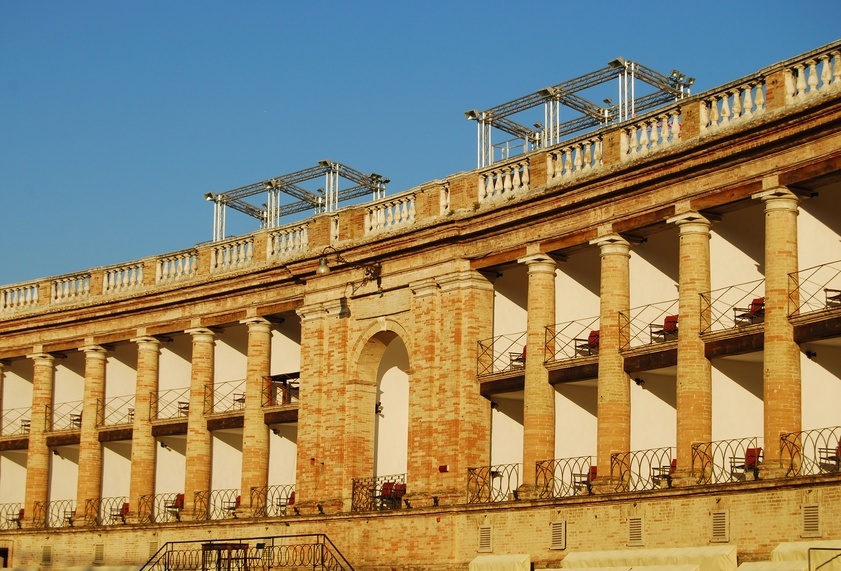
It also has the extraordinary Sferisterio, an enormous neo-classical arena built in 1820 by public subscription. Every Summer a world famous open-air opera festival is held here. I was entranced by the thought that Macerata’s citizens had loved opera enough to build their own venue until I learned that it was originally erected to stage games of that other great Italian passion, soccer. Or, more specifically, pallone col bracciale. A hugely popular sport from the mid 16th to early 20th century, pallone players were once the highest paid athletes in the world.

The pallone field is distinctive in that it has a lateral wall for rebound of the ball. In effect it’s a half arena, an ovoid split down its length and perfectly designed, ‘post-pallone’, to morph into an open-air opera venue. With dozens of private boxes situated between soaring columns, dramatic accent lighting and perfect acoustics, the Sferisterio has become world famous. 


Sferisterio - Photo by Drimi
But it’s not just about universities and opera. The Corso Matteotti is lined by beautiful palazzi reminding us that although this region was traditionally quite poor, relying on agriculture and crafts, it was under local lords for much of its history. Amongst the most distinguished palaces is Palazzo Marefoschi. In this grand house Bonnie Prince Charlie, ‘the Young Pretender’, was married in 1772.

Palazzo Marrefoschi, photo by Mi Ti, Fotolia.com
One of the most attractive aspects of Macerata and the region in general, is that the citizens speak little or no English. Local restaurants don’t spruik for business by cycling competently through half a dozen languages till they hit on yours and no one at the hospital, including doctors, spoke English (which I found to my cost). It has all the hallmarks of real life in a regional Italian town rather than a made for tourists experience.

For my next book I’m heading to the Australian outback. I love the huge horizons, vibrant colour, and eccentric characters found in this vast area. Beyond that, Colorado and New Mexico are on the radar for next year. I’m keen to see the Pueblo de Taos adobe structure in Taos and to experience the artistic communities of both Taos and Santa Fe. I’m sure there’s a story in there somewhere.