Showing posts with label recipe. Show all posts

Wednesday, November 23, 2011

A Favorite of the Pharaohs

As I write this, I’m preparing to drive 15 hours to Tennessee to a huge family gathering where, on Thanksgiving Day, we’ll mark the occasion by dining on both traditional American and Indian meals. But my mind right now is on my latest manuscript, set in Cairo, and the big spread of comfort foods Egyptians enjoy there every year. 

Not at Thanksgiving, mind you, but on a smaller scale, every evening during Ramadan with the iftar fast-breaking meal just after sunset, and especially on the final evening of Ramadan, with the traditional feast of the Eid ul-Fitr. Muslims the world over celebrate the end of Ramadan with the Eid dinner in celebratory fashion, surrounded by family and friends.


Each country has its own special dish (dishes, really) that you can count on to be served at either the iftar or especially on Eid. In Algeria, it’s harira, a lamb and chick pea stew simmered in tomatos and herbs, or lahm lhalou, a dish of lamb stewed in prunes. In Turkey, it might be kobete, a savory pie filled with chicken and buttery rice. In Iran, it could be aash, a hearty herb, bean, and rice-based soup. In South Asia, it might be rogan josh, a thick, dark Kashmiri stew often made with lamb or mutton; chicken jalfrezi, a colorful saute of onions and bell peppers; and maybe pakoras, an appetizer of deep-fried savory fritters. All over Southeast Asia, ketupat, a type of rice-filled dumplings, are enjoyed. In Saudi Arabia, it’s mofatah al-dajaj, an elaborate braised lamb dish garnished with sauteed sliced onions, almonds, and raisins.


In Egypt, as in most countries, Eid is marked by giving out sweets and taking small holidays, maybe to the beach or to visit family. Egyptians feast, party really, for three days. Families either buy and distribute kadk, a type of Middle Eastern sugar cookie, or make them together as a holiday tradition. 


The Egyptians usually break their fast by eating dates or a drink of qamar-eddeen, an apricot juice filled with bits of nut and fruit. The first dish is usually a lentil soup, and all over the table, you’ll find tiny bowls and plates of small savory treats, such as baba ganoush, pureed roasted eggplant with tahini and garlic, bowls of olives, and so on.


One small dish that is commonly seen on an Egyptian table during iftar, Eid, or even as a common breakfast item is ful medames, a thick, savory dish of slow-cooked fava beans seasoned with lemon, garlic, olive oil, and a few spices. It’s a simple comfort food that even the pharaohs once enjoyed.


Bon appetit, or as the Egyptians would say, bil hana wish shifa'!


Ful Medames (recipe borrowed from Epicurious.com):


Ingredients:
  • 2 cups small Egyptian fava beans (ful medames), soaked overnight (and left unpeeled)
  • Salt
  • 1/3 cup chopped flat-leaf parsley
  • Extra virgin olive oil
  • 3 lemons, quartered
  • Salt and pepper
  • 4–6 cloves garlic, crushed
  • Chili pepper flakes
  • Cumin

Preparation: 

As the cooking time varies depending on the quality and age of the beans, it is good to cook them in advance and to reheat them when you are ready to serve. Cook the drained beans in a fresh portion of unsalted water in a large saucepan with the lid on until tender, adding water to keep them covered, and salt when the beans have softened. They take 2-2 1/2 hours of gentle simmering. When the beans are soft, let the liquid reduce. It is usual to take out a ladle or two of the beans and to mash them with some of the cooking liquid, then stir this back into the beans. This is to thicken the sauce.

Serve the beans in soup bowls sprinkled with chopped parsley and accompanied by lavash or pita bread.
Pass round the dressing ingredients for everyone to help themselves: a bottle of extra-virgin olive oil, the quartered lemons, salt and pepper, a little saucer with the crushed garlic, one with chili-pepper flakes, and one with ground cumin.

The beans are eaten gently crushed with the fork, so that they absorb the dressing.

Variations
• A traditional way of thickening the sauce is to throw a handful of red lentils (1/4 cup) into the water at the start of the cooking.
• In Iraq, large brown beans are used instead of the small Egyptian ones, in a dish called badkila, which is also sold for breakfast in the street.

Optional Garnishes
• Peel hard-boiled eggs—1 per person—to cut up in the bowl with the beans.
• Top the beans with a chopped cucumber-and-tomato salad and thinly sliced mild onions or scallions. Otherwise, pass round a good bunch of scallions and quartered tomatoes and cucumbers cut into sticks.
• Serve with tahina cream sauce or salad, with pickles and sliced onions soaked in vinegar for 30 minutes.
• Another way of serving ful medames is smothered in a garlicky tomato sauce.
• In Syria and Lebanon, they eat ful medames with yogurt or feta cheese, olives, and small cucumbers. 

Friday, November 11, 2011

Off The Beaten Track: Tokyo

Today’s Off the Beaten Path contributor is Robb Grindstaff, a fiction writer and book editor whose first career was in journalism and the business world of news media.  Robb has had several short stories published in various anthologies and magazines, and his articles on the craft of writing have appeared in writer magazines and websites. He writes the ‘Ask The Editor’ blog, and has edited book manuscripts (fiction and non-fiction) for published and agent-represented authors from the U.S., Australia, and Europe. He is currently marketing his second novel to agents, writing his third, and hiding the first one deep in his laptop. During his journalism career, he served in various editorial and management positions, including executive editor and general manager of an international English-language newspaper, which landed him a five-year assignment in Asia, where he ate his way through one country after another.

Before we get to Tokyo, a bit about my food bio and how I got my reluctant taste buds to travel with me. I grew up in mostly small, rural towns in the southern and Midwest U.S.  Our family dinners consisted of meals like pot roast, meatloaf, fried chicken, and pork chops. Potatoes might be mashed or baked or fried. Corn or green beans or peas as a side, which I would never eat. I was the picky eater.

Good, sturdy food, not spicy or heavily seasoned. And Mom usually cooked the meat somewhere between medium well and well done, a habit from the days on the farm when undercooked meat could kill you and the nearest doctor might be a half-day’s travel away.

Osezaki, it's breathtaking underwater or above.
When I was in high school, we moved to Arizona, the Great American Southwest, and my culinary experience broadened tremendously with the introduction of Mexican food. I learned you could season meat more generously and wrap it in a tortilla rather than put it on a bun. My universe of food expanded exponentially.

Then, I met my wife. She’s half-Italian, half-Cajun, which largely explains why I married her. She introduced me to the joys of Tabasco sauce and cayenne pepper. She serves rice more often than potatoes. I’d only known rice as the stuff charities sent to starving people in famine-stricken, third-world countries. I didn’t know people ate it by choice.

She also introduced me to seafood. Growing up, fish wasn’t big on our family menu. As a kid, it meant frozen fish sticks heated up in the oven. Occasionally, it meant someone went fishing and brought back some catfish or perch, which would be filleted, coated in cornmeal, and deep fried until it was thoroughly cooked, then cooked another minute or two just to be safe.

But with my wife’s pot of gumbo came shrimp and crab and oysters and who knows what else. And crawfish etouffee.  I proposed after the etouffee.

Even with all these expanded horizons, there was one food I did not understand and knew I would never touch.

Sushi. Sashimi. I didn’t care what you called it. I knew what it was. Raw fish. In Texas, we called it ‘bait.’

You might find Nemo on your plate at dinner.
Why anyone would eat uncooked fish was beyond my comprehension. How anyone could eat uncooked fish and not wind up in a hospital with food poisoning, e coli, salmonella, or botulism escaped me. The mere thought of putting a piece of raw fish in my mouth churned my stomach.

So what did I do a few years ago? I accepted a job in Japan.

We soon made some wonderful Japanese friends who took us out to dinner for the ‘real Japanese experience.’ A sushi restaurant. In a private room – with karaoke of course. Not only do I not eat raw fish, I don’t sing in public. Ever.

Who gets to do all those dishes?
I was quite prepared for a very lousy evening. The lousy evening was confirmed when the waitresses hauled in large platters of seafood. Beautifully prepared and plated works of art. Raw fish, cut and arranged into intricate designs, an explosion of colors, and a few hundred tiny bowls of different color sauces. Remarkably, no fishy smell. But still. This stuff was uncooked and therefore unfit for human consumption.

My friend Hayashi-san asked if I’d like to try the tako.

“Yes, tacos!” Definitely. I didn’t know they served tacos too. Beef preferably, although chicken would do.”

He served up a slice from a giant octopus tentacle onto a tiny little plate and handed it to me. It still had the suction cup on the outer edge. He pointed to one of the sauces in the middle of the table – his recommendation for the tako.

Or go catch it yourself, like this early riser.
If there’s one thing I try to avoid even more than raw cephalopods, it’s being rude to someone who takes me out to dinner. With my hashi, I picked up the slice of white meat with the reddish-orange outer ring (and suction cup) and dipped it into a sauce. I hoped I could get it down without pulling a President Bush 41 and vomiting on my Japanese hosts.

Absolutely exquisite. Tasted more like lobster than whatever I had expected. Delicate, not at all chewy or rubbery as I’d anticipated, and the sauce exploded with flavor.

That’s all it took. From then on, there was no stopping me. I ate raw octopus, shrimp, squid, crab, several kinds of tuna, salmon, anything that used to swim, float, or squirt ink. I tried all the sauces. The smooth ones, the soy-based sauces that were a little salty, the spicy sauces, and my favorite, the wasabi that would clear your sinuses and set your hair on fire.

Soon afterward, I discovered the cheap lunch counters where pieces of sashimi lazily drift by you on a conveyor belt and you grab the ones you want and eat until you’re full, then total up the damages, and walk out wondering how in the world you could eat so much for so little money.

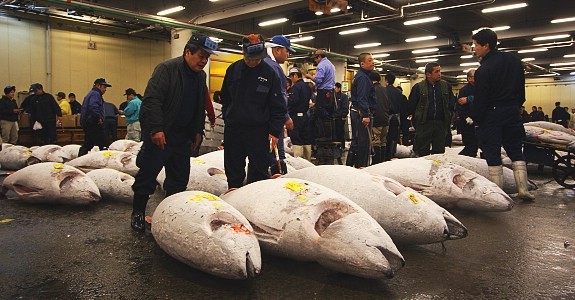
If you’re in Tokyo, you can’t go wrong with sushi, whether you’re at an elegant restaurant, a truck stop, or an airport kiosk. The seafood on your plate may have been pulled out of a tank moments before it landed on your plate, or it might have been hand-selected earlier that morning at the Tsukiji Fish Market.

The fish market – especially the tuna auction – is a mandatory stop if visiting Tokyo.  Get there early (say around 4 a.m.), and wear old shoes as you might be sliding around in a little fish muck on the floor.

Then head across the street from the market to one of the many small restaurants for lunch. The only way to get fresher seafood is to dive into the ocean and catch it in your teeth.

As for karaoke, however, I still won’t do that.

The only way to find fresher seafood in Japan is to go get it yourself.

Wednesday, June 22, 2011

Salad Days

Among the many amazing legacies my mother in-law has left us are a small collection of notebooks she’d written over the years, notebooks filled with unique, varied, and scrumptious Indian recipes I’d often never tasted or even heard of till she introduced them to me. 

And as with most great cooks, nearly all her recipes came with a lovely, long-ago story, maybe about the person who taught her the dish or the esteemed dinner guest she prepared it for the first she had them over. Sounds mundane, but in her retelling, there was magic. As she compiled the recipes, I asked her to jot down some of these stories so I could tell my own kids when they start expressing their own creativity in the kitchen.

Somehow, one recipe is missing from these notebooks, but it’s the one I can’t forget since I make it so often. It’s a type of raita, or an Indian salad mixed with yogurt, and while my mother in-law certainly didn't invent this dish, she taught me how to make it.

Raita itself is a common dish, basically any combination of chopped raw vegetables (or even fruit) mixed with plain yogurt and  seasoned with salt, but there are literally endless variations of this concept. The most common vegetables used are tomatoes, cucumber, and onions, but I’ve seen versions with almost anything – pineapple, carrots, beets, apples, green chilies, raisins. Seasoned powdered spices, such as chaat masala or chili powder, can be sprinkled in with the salt. Sometimes, a blend of whole spices (cumin seeds, for instance) is fried separately and mixed in. Cilantro and/or mint may be chopped and added in or garnished over the top. Another version of raita that I enjoy includes corn and pomegranate kernels with a garnish of mint and a dash of salt, sugar, and coriander powder.

But the one I’m sharing this week, an eggplant raita, is my favorite. I seriously crave this dish nearly all year round, but most especially now, in the hot summer months, as a quick, cool accompaniment to almost any meal, especially kebabs, or as a dip. In Konkani, we call this dish “bujjee” (at least that’s the phonetic spelling), or "bajji," which is also the word we use for anything mashed, edible or otherwise.

Here's how you make it.

First, you’ll need the following (approximated quantities):

1 large eggplant
1–1.5 cups of yogurt (I also like to add in a couple spoons of sour cream)
1/3 cup finely chopped red onion
1.5 Tbsps grated ginger
a few pinches of finely chopped cilantro (optional and to be added at the very end)

for the seasoning:
1 Tbsp of oil
1 green chili, slit down the middle, seeds removed
3 pods of garlic, peeled and just slightly crushed to release the juices
combination of whole spices: 3/4 tsp black mustard seeds and ½ tsp of cumin seeds
10-12 curry leaves (optional, but if you want to try this, you’ll find it in the refrigerator section of any local Indian grocer)

Method:

Cut some slits into the eggplant then place it on a hot grill or in a preheated broiler for about 30-45 minutes. I use a baking dish with sides when I use the broiler because of all the oil that’s released. Keep turning the eggplant, every 15 minutes or so, until the eggplant starts to collapse. When it’s cool enough, scrape the flesh out of the skin, mash it in a bowl with the back of a fork, then combine ginger, onions, yogurt, and about a teaspoon of salt. (I mix in some of the released oils from the baking pan too.) You’re looking for the consistency of a medium-thick dip, so add additional yogurt or sour cream in case it’s too thick.

Separately, in a small sauce pan, heat the oil on medium heat. When the oil is good and hot, add first the mustard seeds – and as soon as it splutters (almost immediately), add the cumin seeds, green chili, garlic pods, and curry leaves. Stir for about 30 seconds  –  or just long enough to soften the pieces of garlic and chili and release the aromas of the whole spices  – then remove from heat.

Pour the contents of the sauce pan into the eggplant mixture and stir. If you’re using the chopped cilantro, mix it in or garnish just before serving. (Note, the curry leaves aren’t meant to be eaten, only to flavor the dish, so you can either remove them before serving or pull them out as you eat.)

If any of this sounds complicated or if you have trouble finding any of the seasonings easily, no worries. You can swap out most of these ingredients, omit what you don’t have, or skip the ginger and/or onions if you don’t care for them. The broiled eggplant, yogurt, and maybe the salt are the only must haves here, with any variation you can think of. 

That said, I dare you to make it my way and not eat the whole bowl before it hits the dinner table.

Enjoy!

Tuesday, June 21, 2011

Confessions of a Traveling Foodie

There are two factors that determine my affection for a country:

1/ The attitude of the people

2/ The quality of the food

I’ve been very fortunate to have had a 99% success rate with the countries I’ve visited (only one country has disappointed me, and no, I won’t share!). As a self-confessed foodie, I keep a “food diary” when abroad. It’s full of recipes I’ve collected from chefs and new-found friends, and every recipe has an entry about where I first tried a particular dish, my first impressions of the place, and the people I shared the meal with.

On top of my food adventures list is Ushuaia, Argentina. Situated on Tierra del Fuego, Ushuaia is the southernmost city in the world (although the Chileans will dispute this—don’t get them started). Located on the icy shores of the Beagle Channel and surrounded by the Martial chain of mountains, Ushuaia could easily be mistaken as a seaside town in Scandinavia. It’s now a stepping off point for boat trips to Antarctica, but for me, Ushuaia is where I had one of the most wonderful experiences in my life—even though I didn’t know it at the time.

Somehow I’d stumbled upon a hostel owned by a couple who looked like they’d just stepped out of a hippie commune. My gentle hosts knew little English, but smiled and made me feel welcome the minute I knocked on their door. Although the hostel rooms were small, the communal living area had a massive floor-to-ceiling window with some of the most magnificent views of Ushuaia. Snow-capped mountains framed the steely gray waters of the port where yachts bobbed up and down. Off in the distance were penguin colonies, and some of the world’s most remote ranches. My planned stay of a week stretched into a month.

In the back of the hostel was a shiny, stainless steel kitchen. Guests had access to the fridge, ovens, and cooking utensils, and most nights a cook-off would take place. Travelers from all over the world made their favorite recipes to ward off homesickness, and it was a delight to try out meals from far-flung locales. But things changed dramatically when Rosa and Paulo from Mendoza, Argentina, arrived.

I’d only been in Argentina a short time so I was still testing the waters with my rudimentary Spanish. A trip to the supermarket that should have taken 10 minutes would drag into an hour because I had to pull out my dictionary every time I read a label or needed to ask for something. It hadn’t worried me, but Rosa decided to take me under her wing, and I quickly became her pet project. Determined for me to get a grasp on the language, Rosa dragged me to the markets, confiscated my Spanish/English dictionary, and made me memorize words and phrases. This curvy, pint-size woman with red, frizzy hair scared the crap out of me. She smiled as she barked orders, and I obeyed by reciting my fruits and veggies, hoping this tough love would pay off. Either that, or very shortly, Rosa would jump onto a plane back to Mendoza.

The view from the hostel window in Ushuaia
After a few days, Rosa handed me a piece of paper written in her cursive script, with her g’s and y’s dropping down two lines. Of course, the note was in Spanish. She told me she’d organized for a feast at the hostel that night, and I was going to be in charge of the empanadas. That’s when I tried out some choice Spanish phrases. She shrugged, handed me a plastic bag of ingredients, and said she’d be back shortly.  

I peered into the bag, found the empanada ingredients, and stared at the note. Mierda. I could barely boil water without burning the bottom of the pot; how on earth was I going to make empanadas and feed the hungry hordes? Everyone else was out on excursions or at a bar that afternoon, so I was alone in the large, cold kitchen and felt very, very lonely. The door banged open, I looked up, and Rosa waddled in clasping a couple of bottles of fine Mendocino Malbec.

She pulled out a couple of juice glasses, cracked open the bottle, poured the dark red liquid, and handed me a glass. We toasted to our health, I made a silent wish that I wouldn’t kill anyone with my cooking, and we set to work. That rainy afternoon, I learnt some Mendocino slang and what it’s like to like to grow up in Mendoza. I also increased my Spanish vocabulary ten-fold. Rosa showed me how to lovingly make the dough and filling, and how to shape these delights into little half moons, complete with swirly patterns. Little did I know, this experience was the start of my life-long love for the city that eventually became my home—Mendoza.

That night, we pushed the tables together, sat our 20+ guests down, and fed them some of the most delicious empanadas I’ve ever tasted (yes, I say so myself!). These pastries were made with love, laughter, and friendship and that flowed through to the group gorging themselves between animated conversations and taking large gulps of wine.

Months later I met up with Rosa and her husband in Mendoza, and we shared more cooking adventures. Her passion for her country’s food and love of people rubbed off on me, and now I enjoy introducing new dishes to friends and family. Although occasionally I still burn the pot that’s supposed to boil water.

And here’s the delicious empanada recipe:

Filling:
1 tbs olive oil
1 onion, finely chopped
1/2 tsp ground cumin
1/2 tsp ground cinnamon
1/2 tsp paprika
Large pinch of ground nutmeg
Large pinch of ground cloves
3 hard-boiled eggs, peeled, coarsely chopped
15 pitted black olives
Melted butter, to brush

Pastry:
3 cups of plain flour
100 grams of chilled butter
1 tsp salt
1 egg yolk, lightly whisked
5 tbs chilled water

Heat the oil in a large frying pan. Add the onion, stir until it is clear and soft. Add the ground beef, stirring with a wooden spoon until brown and cooked through. Add the cumin, cinnamon, paprika, nutmeg, and cloves. Stir again and transfer to a large heatproof bowl. Leave in the refrigerator for 30 minutes. 

Make the pastry by placing the flour, butter and salt in a blender. Process until it looks like breadcrumbs. Add the egg yolk and water and process again until the dough starts to cling. Take out and place on a floured surface and knead the dough until all lumps are removed. Wrap in plastic and place in the refrigerator for about 20 minutes.
Line 2 large baking trays with baking paper. Turn on oven to 200C. Roll out the pastry until it is around 3 millimetres thick. Cut the pastry into 15 discs, 12 centimetres in diameter. 

Stir the egg into the ground beef and mix with the seasonings. Place a heaped tablespoon of ground beef in the centre of the pastry disc. Top with 1 or 2 olives and brush the edges of the pastry with water. Fold so it is in the shape of a half moon. Press the edges together and use a fork to crimp the edge. Place on a lined tray and repeat this until all the empanadas have been made. Put it in the refrigerator for 30 minutes. Brush the empanadas with melted butter, bake in the over until golden (around 25 minutes). Eat and enjoy!

Monday, November 22, 2010

Vintage Garlic

In my pantry stands a glass jar filled with what looks like tiny twigs poking out of slimy black mud. Not an appealing sight. Yet it is the most precious item in my kitchen—seer torshi (pickled garlic). Heaven on a plate.

The first time I saw the nasty-looking black mess, I eyed it with deep suspicion. Whole round bulbs of garlic, darkened with age, lying in a viscous liquid. Surely no one actually ate that and lived to tell the tale.

I sniffed the jar. It didn’t smell too bad. In fact it had a pleasant, woodsy odor, like last year’s leaves after a snow melt. One with a slightly vinegary bite. Once, the garlic had been white and the vinegar clear, but over the years it darkened to black, the papery skin covering the cloves disintegrating and thickening the liquid. It put me in mind of little mummies, their wrappings falling apart with age.

My mother-in-law explained the condiment’s origins. Her grandmother had made the seer torshi forty years earlier, and every time the family ate it, they could feel her presence with them. Sure, I thought, doesn’t everyone have some item that reinforces an emotional bond with a long-gone loved one? Usually it’s a handmade quilt or a knitted sweater, not something you're supposed to eat.

I remembered the way my mother used to can our garden’s summer bounty. Packing vegetables into jars and processing them in a hot water bath then testing the lids for a proper seal. These garlic pickles had surely never seen the inside of a canning kettle. Thanks, but no thanks.

It took me several years to work up the courage to try the seer torshi, as its age marched relentlessly on toward half a century. We serve it a couple times a year, on special occasions like Persian New Year—the perfect accompaniment to the traditional holiday meal of grilled fish and herbed rice. But for a long time, I was certain that one bite would send me directly to the emergency room. Despite concrete evidence to the contrary.

I’d watched my husband and his relatives scrape the tattered remnants of skin off the cloves, lick black vinegar from their fingers, and pop the cloves into their mouths, savoring every bite. Maybe they had developed an immunity to the microbes that had to be lurking in that murky liquid. The way that Mexicans can drink their tap water without falling victim to Montezuma’s Revenge.

It was only a matter of time before curiosity banished caution, and I tried one small clove. Just a nibble to begin with. I was hooked from the first bite. Smooth and buttery, with a mild vinegary tang on the tongue, as though most of the vinegar’s sting has evaporated over the years.

Seer torshi is easy to make; you don’t even need a recipe. Just take a gallon-sized glass jar with a tight-fitting lid and wash it thoroughly. Fill it two-thirds full of garlic bulbs, hard stems removed. You can separate the cloves, but leave the skins on or the garlic will turn to mush. Cover with vinegar and toss in a tablespoon of salt. Then cover the jar with plastic wrap for a tight seal before replacing the lid. Wait seven years and enjoy. Preferably longer because, like good wine, seer torshi only gets better with age.

As our supply of great-grandma’s pickled garlic dwindles, we serve it only at Persian New Year now. And when we sit down to the meal, it’s like the old lady is sitting beside us, smiling and murmuring noosh-e jaan. Bon appétit.

Do you have a special food tradition, recipe, or dish that brings back memories of relatives now gone?

Friday, October 29, 2010

Off the Beaten Track: Roman Chestnuts

Our guest this week is Patricia Winton, who writes traditional mysteries that focus on Italian cuisine, inspired by years of eating in the country. She has enjoyed languid summer lunches under a grape arbor in the Tuscan hills, shared a dish of tripe with complete strangers sitting elbow to elbow at a Florentine market, and learned to make pasta by hand from an Italian chef. Her work features an Italian-American journalist who has returned to her mother’s native Italy after losing her job when her newspaper folds, her husband when he finds a younger model, and her mother when breast cancer wins the battle. A native of the American South, Patricia now lives in Rome. She is a member of Sisters in Crime and its Guppy chapter.

My first apartment in Italy was on Via dei Castagni, Chestnut Tree Street. It was a funny little apartment with a kitchen where both the top of the fridge and the sink struck me below my hip bone. I always entered the kitchen in a crouch. When I moved there I’d never seen a chestnut tree because disease had destroyed most of those in North America at the beginning of the twentieth century. Oh, I’d seen beautiful old furniture crafted from chestnut wood, and I’d memorized portions of Longfellow’s “Under the Spreading Chestnut Tree” in school, so the name of my street had a romantic allure. It was inevitable that I would fall in love with chestnuts while I lived there. Now, many years later, I always think of that apartment at chestnut harvest time.

And chestnut harvest time it is. In the chestnut woods, where the trees can soar to 50 feet (15 meters), families carry baskets and wear protective gloves to gather these jewels. The nuts have a spiny outer shell that can really stick you. Fortunately, these outer shells tend to split open before the nuts fall. Each one contains two to five chestnuts, and when they fall, it seems that more chestnuts occupy that outer spiny shell than lie on the ground. Thus the gloves. In the markets, mounds of these shiny brown orbs are appearing. I walked up and down the market yesterday looking for the biggest ones I could find. I boiled some last night with a bay leaf. They are so sweet that I’ve eaten almost all I cooked even though I wanted them for tonight’s dinner.

And best of all, the caldarrostai, roast chestnut sellers, are setting up their grills in the piazzas in central Rome. The aroma of roasting chestnuts wafts up the Spanish Steps and meanders through narrow little streets. The caldarrostaio sits before a large round grill with a lower level filled with charcoal and a flat, perforated top. He slits the chestnut shells with a sharp, short-handled knife before putting them on the grill. The chestnuts that have already roasted are heaped onto a waiting tray the same size as the grill. The caldarrostaio can maneuver the tray over the grill to keep the chestnuts hot. When a customer stops, he (and they all seem to be men), scoops up a serving of hot chestnuts with a slotted spoon and pours them into a paper cone. The streets are littered with chestnut shells at this time of year.

I love the scent, but I have to admit that I never buy roast chestnuts in the street. I watch tourists eagerly taking their paper cones and give myself a secret hug because I know that I can recreate that aroma and flavor at home. I use a chestnut roasting pan which looks rather like a long-handled frying pan with quarter-inch holes in the bottom.  The caldarrostaio’s grill has a similar surface, but it’s much bigger. You can use these pans over an open fire as in The Christmas Song or over a gas flame on the kitchen stove. Or you can roast them in the oven. One enterprising Italian friend uses the microwave, but his wife points out that the ensuing smoke has discolored her microwave from pristine white to grungy yellow.

One caution, if you decide to roast chestnuts. They are like popcorn. Steam accumulates under the shell, and the chestnuts will explode as they heat up. Because chestnuts are much larger than popcorn, they can become deadly missiles as they burst. To eliminate this danger, you must cut through the shell to allow steam to escape. For years, I tried cutting a circle around the middle of the chestnuts,  but I’ve adapted the method of the caldarrostai. They cut a slit over the curved side so that when the steam escapes, the shell opens up revealing the creamy nut underneath. I slice an X into the flat side with a box cutter. The X opens up, making it simple to remove the shell.

Chestnuts have been a mainstay in the Italian diet at least since Roman times. They are available fresh during the autumn and dried year round. You can even buy chestnut marmalade and chestnut flour. My Encyclopedia of Italian Cooking has almost fifty recipes, ranging from pasta to main dishes to dessert. There’s a beef stew made with dried chestnuts, carrots, and onions; an exotic ostrich steak with chestnuts and raisins; many soups, especially with chick peas; and a host of desserts ranging from puddings to cakes.

Now, I think I'll head for the kitchen to make sausage with chestnuts for dinner.