By Beth
Green
 |
| Photo by JP |
At the age
of nine, when I wasn’t making up elaborate (and slightly shocking) stories
about what Barbie and Ken were up to, I’d devote hours to drawing my dream
house. I pestered my father until he gave me a half-unused notebook of graph
paper. Then I would carefully sharpen all my hoarded Faber-Castell colored
pencils, and set about drawing elaborate, fantastical floor plans. These dreamy
blueprints encompassed private filming rooms for the movie studio I was sure to
one day run, stables full of horses
I’d one
day learn how to ride, swimming pools shaped like mythical beasts, ballrooms
fit for the princess I imagined myself to be, and, in every bedroom, a
white-railed balcony.
For where
would Juliet have been without her balcony?
When I was
18, I finally moved into my own place, a two-bedroom apartment in Moscow,
Idaho, which I shared with a roommate, a couch-surfer, and a friendly ghost who
liked turning my CD player on randomly at night when I was home alone and
scaring the bejeezus out of me. We had a bathtub, a purple carpet, but, alas,
no balcony. The building itself was a handsome marvel of western, small-town
America. Built of red-brick, the former hotel housed some of the town’s best
bars and restaurants and dozens of apartments.
After a
year there, for a few months I lived in a tiny studio apartment tucked under a
common metal stairwell in Bend, Oregon. In the evenings I looked out the
windows at the tenants’ car lot and the ankles of my upstairs neighbors coming
down the stairs, and dreamed that one day, I could rise in the world.
 |
| Photo by JimBap |
Later that
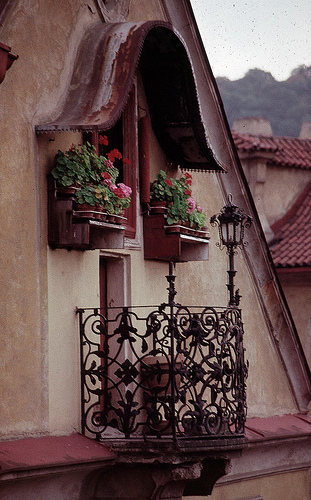
year I moved to Spain, a country whose streets are studded with handsome,
dignified half-moon balconies complete with elegant wrought-iron railings and
pots of bright and trailing flowers. I’d walk down the roads of my neighborhood
during the siesta and gaze up at the green shutters above me. Occasionally, an
old woman would peer down while hanging up her laundry. I’d glimpse TVs
flickering in the living rooms beyond, sleepy cats flicking their tails through
the bars of the balconies. But did I get one? No, I somehow managed to find an
apartment—perhaps the only one in the city?—without a balcón.
After
university I transitioned to working in Florida, in a retirement community
where I’d often tell people how to find me: “Don’t worry, I’ll be the youngest
person in the room.”
The
architecture here matched the terrain—flat. The movers and shakers there had,
not towers, but estates--one-level suburban palaces coiled around the turquoise
shallows of their swimming pool and embraced by green swaths of imported grass.
The residents were protected by 12-foot-high gates, which in turn were
surrounded by strip-malls. A balcony here translated into a terrace, a patio,or
a sun-room. I rented a unit in a converted motel by the beach and fed stray
cats on the cracked concrete path, pretending it was my own Mediterranean
suite.
Travel
called me again, and I answered, starting all over in the Czech Republic. If
Spain is meant to have balconies, then Prague is meant to have spires on its
buildings, but they don’t lack for balconies either. My “flat”—as I took to
calling the plain old American “apartment”—was in a building more than 150
years old. Each day when I walked down my neighborhood streets, I’d gaze up and
notice some new detail—a plaster cherub, a particularly arched window—that I
hadn’t seen before, even after several years of passing by. My building had
squeaky wooden floors, an ample kitchen, double-paned glass windows, and quirky
neighbors, but, again, I lacked a balcony.
 |
| Original oil, Ford Madox Brown, 1870 |
Four and a
half years following in China found me living in an ivory tower separated from
the crowded streets by key-card entry and uniformed guards, in a
haphazardly-split 1980s-built unit in a building too short to warrant a permit
for an elevator (you need six floors or more, too bad if you’re in apartment
501), in an ageing beauty queen of housing estates, where taxi drivers never
needed more than the name of the development to bring me to my door.
And still,
no balcony.
This week,
I’m setting up a new home in Cebu City, Philippines. I’ve looked at a multitude
of places to rent. A two bedroom, brand-new townhouse. A three-bedroom
faded-glory affair on a back street above a shipping company. An upmarket
studio slightly more homey than a hotel room. A minuscule “two-bedroom”
apartment that took out the kitchen to provide the extra bedroom. But all of
them, every single one, has got a balcony. Whichever apartment I choose, I get
to be Juliet. I get to have a balcony.
My
boyfriend’s getting a memo in the morning: Time to start rehearsals. “Tis the East…


