Showing posts with label Canada. Show all posts

Wednesday, June 27, 2012

The Spell of the Yukon, and Other Adventures


By Beth Green

In poetry, as well as novels, I look for verse that takes me to another place; for a lyrical transportation to another time.

It’s no wonder then, that one of the poets whose writing has echoed in my thoughts the most is Canadian Robert W. Service.
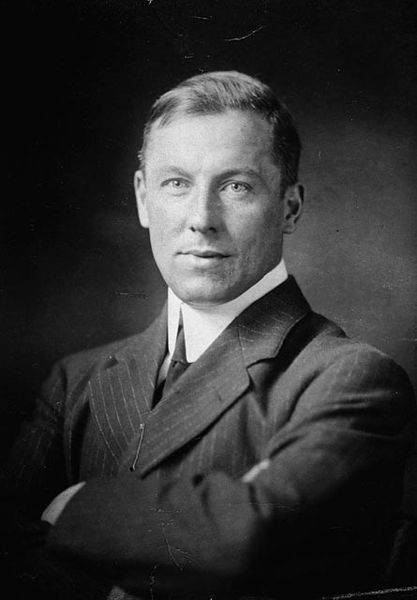
Robert W. Service
A contemporary of American novelist Jack London (White Fang, The Call of the Wild―also great adventure tales), Service wrote the poems that made him famous about the Gold Rush of the late 1800s. Originally Scottish, Service was an adventurer from a young age. He traveled and worked at various jobs in North America, eventually landing work as a banker in the wild north. His poetry―he actually preferred to call it “verse”―is often compared to (or dismissed as) similar to Rudyard Kipling’s in tone, audience and meter.

But the thing that captures me most about Service’s many poems about the Yukon is his sense of adventure. Consider the opening to “A Rolling Stone,” published in 1912.

There's sunshine in the heart of me,
My blood sings in the breeze; 
The mountains are a part of me,
I'm fellow to the trees.
My golden youth I'm squandering, 
Sun-libertine am I; 
A-wandering, a-wandering
Until the day I die.

Service’s poems also brought the world a cast of characters―sometimes desperate―who acted out the dance of life in sub-zero conditions. One of his first famous poems, “The Cremation of Sam McGee,” (1907) tells the story of the death of a gold miner:

Now Sam McGee was from Tennessee, where the cotton blooms and blows.
Why he left his home in the South to roam 'round the Pole, God only knows.
He was always cold, but the land of gold seemed to hold him like a spell;
Though he'd often say in his homely way that he'd "sooner live in hell".

Southeast Alaska. Photo by Beth Green

Having lived in Alaska, I feel that his poetry also illustrates the beauty of North America―particularly Alaska, British Columbia and the Yukon―better than any other writer I’ve read. My favorite example of this is his epic “The Spell of the Yukon,” published in 1907.

The Spell of the Yukon

I wanted the gold, and I sought it;
   I scrabbled and mucked like a slave.
Was it famine or scurvy―I fought it;
   I hurled my youth into a grave.
I wanted the gold, and I got it―
   Came out with a fortune last fall,― 
Yet somehow life’s not what I thought it,
   And somehow the gold isn’t all.
A glacier. Photo by Beth Green
No! There’s the land. (Have you seen it?)
   It’s the cussedest land that I know,
From the big, dizzy mountains that screen it
   To the deep, deathlike valleys below.
Some say God was tired when He made it;
   Some say it’s a fine land to shun;
Maybe; but there’s some as would trade it
   For no land on earth―and I’m one.


You come to get rich (damned good reason);
   You feel like an exile at first;
You hate it like hell for a season,
   And then you are worse than the worst.
It grips you like some kinds of sinning;
   It twists you from foe to a friend;
It seems it’s been since the beginning;
   It seems it will be to the end.
I’ve stood in some mighty-mouthed hollow
   That’s plumb-full of hush to the brim;
I’ve watched the big, husky sun wallow
   In crimson and gold, and grow dim,
Till the moon set the pearly peaks gleaming,
   And the stars tumbled out, neck and crop;
And I’ve thought that I surely was dreaming,
   With the peace o’ the world piled on top.
The summer―no sweeter was ever;
   The sunshiny woods all athrill;
The grayling aleap in the river,
   The bighorn asleep on the hill.
The strong life that never knows harness;
   The wilds where the caribou call;
The freshness, the freedom, the farness―
   O God! how I’m stuck on it all.
The winter! the brightness that blinds you,
   The white land locked tight as a drum,
The cold fear that follows and finds you,
   The silence that bludgeons you dumb.
The snows that are older than history,
   The woods where the weird shadows slant;
The stillness, the moonlight, the mystery,
   I’ve bade ’em good-by―but I can’t.


Mountains above Juneau, AK.
There’s a land where the mountains are nameless,
   And the rivers all run God knows where;
There are lives that are erring and aimless,
   And deaths that just hang by a hair;
There are hardships that nobody reckons;
   There are valleys unpeopled and still;
There’s a land―oh, it beckons and beckons,
   And I want to go back―and I will.


They’re making my money diminish;
   I’m sick of the taste of champagne.
Thank God! when I’m skinned to a finish
   I’ll pike to the Yukon again.
I’ll fight―and you bet it’s no sham-fight;
   It’s hell!―but I’ve been there before;
And it’s better than this by a damsite―
   So me for the Yukon once more.
There’s gold, and it’s haunting and haunting;
   It’s luring me on as of old;
Yet it isn’t the gold that I’m wanting
   So much as just finding the gold.
It’s the great, big, broad land ’way up yonder,
   It’s the forests where silence has lease;
It’s the beauty that thrills me with wonder,
   It’s the stillness that fills me with peace. 

Southeast Alaska
 

Friday, July 8, 2011

Off The Beaten Track: An Arctic Adventure

My nephew Steven, my then-teenagers, Eric and Minetta,
and I in our bug-protective gear preparing to load our canoes.
Dr. Lanice Jones is a Canadian family physician, world traveler, and adventurer in every sense of the word. This week, she shares another one of her many adventures with us.

“What about the Thelon, Mom?” my fifteen year-old daughter and sixteen year-old son questioned. It was mid-May 2006, and we’d been studying maps and reading books about Canada’s Arctic for months. We’d signed up for canoe lessons, bought life jackets and paddles, dry bags, and a new tent in anticipation of a family canoe trip, when suddenly my husband of thirty years ran off with another woman.

“We’re going, kids. I don’t know how, but we’re going to do it together,” I encouraged. “Dad isn’t the only one who can have adventures!”

Caribou crossing the Thelon River. 
I’d fallen in love with the Arctic at seventeen, when I’d worked my first job at a fishing camp in Canada’s North-West Territories. Ever since, I’d dreamed of exploring the Thelon River, Nunavut’s longest river, home to muskox and caribou, barren-ground grizzly and wolves, and I wasn’t going to give up that dream. We’d find a way!

I called my nephew Steve, begging him to be our fourth paddler. Meanwhile, I spent two months drying food, packing dry bags, and a food barrel. The work was therapeutic as I triple-checked meals and gear, too focused to dwell on the great rift in my heart. There would be time for grieving during the weeks on the water, where we’d be entirely alone for weeks at a time.

Our float plane taking off after leaving us
alone in the Arctic wilderness....
We were dropped off by float plane, just east of Warden’s Grove. Black flies and mosquitoes swarmed against our bug shirts, protecting us from being eaten alive as we pushed our way through thick bush to pay homage to the place where John Hornby and his young nephew died of starvation “overwintering” on the Thelon in 1927.

Our time on the water was idyllic as we paddled with the current, searching for a glimpse of muskox or caribou, or trailing a fishing line to supplement our dried food. But land was another matter. I’d spent five summers of my youth in the Arctic, and while I didn’t like the bugs, I viewed them as a necessary evil.


My vegetarian daughter caught
the biggest jackfish!
However, Steve and my kids hated the constant swarm. We’d prepare to land by tugging on our gloves, tightening down our pant legs, and zipping up our bug shirts. We’d have races to see who could get their tents up quickest, then two would prepare the dinner while two would make a cook fire. When dinner was ready, three would enter the dining tent and undertake “the kill,” swiping as many bugs as possible with a handkerchief while the last person would pass through the food and dash inside.

By early August, the wind was kicking up, blowing away the swarm but making paddling difficult. As we approached our pick-up spot, where the Thelon entered Beverly Lake, thunder clouds piled up from the North, and a howling wind tore at the canoes. My son, Eric, and I hugged the lee shore, digging in our paddles, to pull forward a few feet while the wind clawed us backward. We could see where we needed to be, but it took us an hour to paddle a few hundred feet. Meanwhile, Steven and my daughter, Minetta, had taken a different tack and ended up on the windward side of the river, fighting against breaking whitecaps as they strove to close the gap between us. I prayed silently for Steven’s strength to hold as he dug his paddle deeply against the savage water that threatened to drive him and Minetta back to the far shore. It seemed to take forever for them to cross the river, and Eric and I waded into the water to help beach their canoe against the wind.

Eric and I use a tent fly to set a sail on a downwind day.
We were holed up by the wind for four days. We explored empty wolf dens dug into the eskers, long low hills of sand left behind by the retreating glaciers. We scrambled up a pingo, a hill of frost pushed up out of the muskeg and covered with vegetation, gaining a view of the endless tundra stretching in all directions. We even built a hot rock sauna in a sheltered cove using willow branches and our tent flies, warming ourselves after a brisk dip in the river.

Finally, the wind dropped, and in the evening, two motor boats churned up the river, their wakes glistening like silver. Our canoes were tied down safe for pickup at a later date, while we tossed our gear in the fishing boats, eager to get a few miles in before the full dark. A day later, we pulled up to the shores of Baker Lake, our new Inuit friends welcoming us to their community for our last night in the Arctic.

Eric compares his hand to a huge grizzly bear print left on the shore
where we had a swim, made dinner, and quickly left again!
As we shared a simple meal, we talked about the life on the land. Our hosts listened and nodded as my kids described how they’d cooked a meal on a beach covered with grizzly paw prints larger than the prints of our own feet then left the area spotlessly clean as we packed up and canoed downstream for five kilometers to avoid any nocturnal visitors. They described how they’d learned to cook a fish using spruce bows as nature’s grill, and how Steve had taught them to use a map and compass first, before being allowed to check their position with a GPS.

I looked at my sun-burnished crew, glowing with health and the joy of living so close to the earth, and while my heart would feel bruised for years to come, I was also filled with the love and pride of my family and what we’d accomplished on our Arctic Adventure.