Wednesday, November 21, 2012

Diwali, American Style


Credit: Ramesh NG
By Supriya Savkoor 

In a dozen countries from Mauritius to Trinidad and Tobago, Suriname to Fiji, and Myanmar to Guyana, the Indian holiday of Diwali, the Hindu festival of lights, is an official national holiday. In the United States, where I grew up and still live, Diwali has grown from a quiet home affair to a festival celebrated in schools, offices, and party halls in nearly every major metropolis from coast to coast.

While the date of the festival of lights varies each year, it always falls between mid-October to mid-November. When my kids’ attended Montessori school a few years ago, our hearts were full when their American teachers greeted us at the door in saris for this most celebrated Hindu festival, salvar kameezes for the Muslim holiday of Ramadan, and in full crazy costume for Halloween—all within the same week! (Then celebrated Chinese New Year a month after the Gregorian one a few months later.)

Credit: Ethan Lofton
This year, we celebrate Thanksgiving only one week after Diwali. And since we'll be hosting Thanksgiving at our place this year, it seems only fitting that we celebrate Diwali while the whole extended clan is gathered, especially since all of the kids have been raised outside India. Thursday night, we start with our usual fare, a traditional Thanksgiving feast with turkey and all the trimmings, alongside a traditional, mostly vegetarian (but not entirely) Indian feast of mutton curry, paneer masala (spicy Indian cheese curry…or something to that effect), a lentil curry (dal) with spinach, and a cauliflower stirfry. I love that everyone gets to choose their feast of choice that night—or combine options, for those so daring. Imagine a dollop of cranberry sauce on the same plate as a curry dish (yum), a syrupy gulab jamun lolling against a slice of pumpkin pie. Only in America, right?

The following night is the real treat. None of the dozen or so kids who’ll be at our place have ever celebrated Diwali in India, and so we're excited to treat them to our own variation of the centuries-old tradition. We’ll have all the ingredients: traditional attire, sparklers, an exchange of gifts, cocktails (no, seriously), poker. And for the kids, craft time and age-appropriate games. I can’t wait.

Credit: Arne Hückelheim
It’s all tradition but then some. The cocktail party, for example, features a cheese fondue, meatballs braised in mint and honey, and a couple Italian appetizers. The gifts feature characters from Winnie the Pooh and Batman. The sparklers may include (if I get to vote) lanterns we let go of, only to watch float up into the sky (instead of putting diyas, like the one pictured at left, afloat in the river). Later, or maybe earlier, depending on how tired we all are, a show put on by the kids. A modern retelling of the Ramayana, for Diwali commemorates Lord Ram’s return to his kingdom after 13 long years in exile and after, yes, more than a few adventures.

Again, I can’t wait.

Happy Thanksgiving and Happy Diwali to you and yours!

Credit: ISAL Indian Students Association Leuven (Belgium)

Tuesday, November 20, 2012

Is it Cow or Chicken?

By Alli Sinclair

The Argentines observe their independence from the Spanish on the 9th of July every year. This celebration takes place in the middle of the Argentine winter, and as is the tradition with Argentines, they love to celebrate the special occasion with food.

The first Argentine Independence Day I celebrated in that country, I was travelling with an Argentine friend of mine. We were holidaying in Carlos Paz, in the province of Cordoba, and my friend was determined I’d take part in the celebrations, which included eating locro.

At the time, my Spanish was dodgy to say the least, and as his English wasn’t crash hot, we spent a lot of time drawing stick figures on serviettes and miming. It always gave us a good laugh, especially when we went to a restaurant on the evening of independence day and my friend tried to explain what ingredients were in Locro.

The conversation went something like this:

Me: “Locro. What’s in it?” I throw my arms thrown out in a questioning manner.

Him: “Es rico.” He rubs his stomach and rolls his eyes like he’s just tasted the best food on earth.

Me: “Yeah, but what’s in it?”

Him: He holds his arms out in a circle to signify a pot then makes a chopping motion like he’s murdering vegetables and proceeds to moo like a cow and oink like a pig.

Me: “So there’s no brrk brrk brrk?” I flap my arms like a chicken.

Him: He shakes his head and moos and oinks again and we both dissolve into laughter which causes the waiter to frown and tsk-tsk us.

The waiter eventually arrived with our dish and the aromas made me want to rub my stomach and roll my eyes just like my friend had done. We added chimichurri, a spicy sauce popular in Argentina and dipped bread into the casserole-like meal. That was the moment I fell in love with locro, and now, even after all these years, when I’m craving some comfort food, I make locro and it always does the trick.

For those of you heading into the cooler months of the year, here’s a recipe for Argentine locro. It’s easy, although a tad fiddly, but I promise you the effort will be worth your while. Just remember, the secret is to cook it slowly over a low heat for an extended period of time.

This recipe is borrowed from the wonderful blog, Seashells and Sunflowers.

Ingredients
1 cup dried white corn (hominy)
2 medium onions, coarsely chopped
2 cloves garlic, thinly sliced
2- ¼" thick slices of smoked pancetta or slab bacon, cubed
2 chorizos colorados or other slightly spicy sausage, sliced
2- 1" thick pieces of osso buco (beef shanks), or similar cut
2 ears of fresh yellow sweet corn, cut the kernels off the cobs
1 tsp. ground cumin
1 tsp. paprika
2 bay leaves
salt to taste
½ tsp. freshly-ground black pepper
1 ½ c. butternut squash, peeled and diced small
1 ½ c. yams, peeled and diced small
1 large baking potato, peeled and diced small
2 plum tomatoes, cut in small wedges
chopped green onion for garnish (optional)
chili oil (see directions)

Directions
Soak the hominy in 2 cups of water overnight (a minimum of 12 hours).

The next day, prepare the chili oil in advance by soaking a teaspoon of ají molido (or crushed red pepper flakes) in a tablespoon of olive oil for 2-3 hours.

Place the onions, garlic, pancetta, chorizo, and osso buco in a large stewpot. Cook over medium heat until the onions are translucent. Add the fresh yellow corn, cumin, paprika, bay leaves, salt, and pepper. Continue to cook, stirring regularly, for roughly 10 minutes. Add the soaked hominy, including the soaking water. Add hot water to the pot to about 2 inches above the level of the ingredients. Add the remaining vegetables, stir, and bring to a boil. Reduce the heat and simmer, covered, stirring every 15-20 minutes, for at least 2 hours.

At this point, uncover the pot and remove the bay leaves. Remove the pieces of osso buco and discard the bones. Cut the meat into bite-sized pieces, then return it to the pot. Continue to stir over low heat, and using the back of a wide spoon or spatula, press the ingredients up against the sides of the pot so that the starchy vegetables and tomato break down into the soup (the corn and meat will resist being mashed). As you continue to stir, mash, and cook; the soup should gradually thicken. Continue until the locro reaches the rich consistency of a stew. Add salt to taste.

Serve in bowls, and garnish with green onions and a touch of chili oil.

Monday, November 19, 2012

A Bejeweled Feast

By Heidi Noroozy

The holiday season is upon us. I know this because Christmas lights, Santa Claus figures, and candy canes are winking at me from store-front displays all over town. And it’s not even Thanksgiving yet. But the turkey feast is just a few days away, so naturally my thoughts turn to food.

Thanksgiving is probably our most quintessentially American holiday. Even recent immigrants will set aside the familiar flavors of the old country and serve a roast turkey with all the traditional trimmings. One of the best Thanksgiving meals I ever tasted was prepared by my husband’s Iranian cousins in Los Angeles. You can read all about it here.

I like to mix things up culturally, so my holiday feast has Persian flavors along with the American ones. There will be some sort of roast fowl on the table this coming Thursday, but it won’t take center stage. That exalted position will be occupied by a big platter of javaher polo, a Persian rice dish that looks like the cook scattered brilliant gemstones over a mound of snow.

Javaher polo is traditionally served at weddings, and for good reason. It is a joyful dish that offers a celebratory blend of colors, flavors, and textures. White rice sparkles with pistachios, orange peel, and ruby-toned barberries (zereshk), finished off with a splash of golden saffron. This dish is good hot or cold, paired with chicken kebabs or Thanksgiving turkey, served on its own for a quick snack or with a spoonful of yogurt on the side.

Like the holiday meal itself, I’ve messed with the traditional recipe for this dish by replacing some of the traditional orange peel with tangerine, which makes the rice even more fragrant. And I’ve added a secret ingredient. I’ll share it if you promise not to tell.

Come closer, and let me whisper it in your ear…

Rosewater.

Not too much. Just a drop or two. You don’t want your rice to smell like a summer garden. It’s November, after all.

So if you’d like to add a bit of Persian flair to your holiday meal this year, hold the mashed potatoes and serve a platter of javaher polo. Here’s the recipe:


Ingredients:

1 orange (peel only)
2 tangerines (peel only)
2 medium-sized carrots, julienned
½ cup sliced pistachios
1 cup slivered almonds
1 cup zereshk (barberries), available in Middle Eastern markets*
½ cup sugar
½ teaspoon powdered saffron dissolved in 3-4 tablespoons of hot water
Splash of rosewater (optional)
3 tablespoons butter

For the rice:

2 ½ cups Basmati rice
8 cups water
3 tablespoons oil
¼ teaspoon ground saffron dissolved in 2 tablespoons water

Directions:

1.   Rinse the rice in several changes of water. Cover with more water, add 2 tablespoons of salt and soak for at least one hour.

2.   Cover the barberries with cold water in a bowl and let stand for at least 20 minutes so any grit will sink to the bottom.

3.   Quarter and then peel the oranges and tangerines. Remove the white part with a sharp knife and discard. Cut the remaining peel crosswise into strips. Cover with cold water in a small saucepan and bring to a boil. Drain and rinse in cold water.

4.   Melt the butter in a large frying pan. Add the carrots and sauté until they start to soften, about 5-10 minutes. Add the citrus peel and nuts and sauté for another 5 minutes. Add salt to taste.

5.   Scoop the barberries out of the water, making sure that the grit remains at the bottom of the bowl, and add to the carrot/orange peel/nut mixture along with the sugar. Stir until the sugar dissolves. Add the saffron water, bring to a simmer, cover the pan and simmer on low heat for 20 minutes, adding more water if the mixture gets too dry.

6.   Bring the 8 cups of water to a boil in a large non-stick pot and add the rice. Cook until al dente (firm to the teeth, but no longer hard). Drain and rinse with cool water.

7    Heat the oil in the same pot and layer the rice with the carrot/orange peel mixture in a pyramid shape, starting and ending with rice. Poke some holes in the top to let the steam escape and sprinkle 1/4 cup of warm water over the top. Cover with a tight-fitting lid wrapped in a clean dish towel, lower the heat and cook for 40-50 minutes. Uncover and pour the saffron water over the top. Cover again and cook for another 5-10 minutes

Noosh-e jaan! Bon appetit!

* Dried cranberries or cherries can be substituted for the barberries, but you’ll need to use less sugar. Barberries are very sour.

Friday, November 16, 2012

Off the Beaten Track: Italian Style

This week’s Off the Beaten Track contributor is the wonderful Louise Reynolds, a contemporary romance author who lives in Melbourne, Australia. By day she works in the commercial lighting industry, lighting anything from bridges to five star hotels. By night she’s working her way through a United Nations of fictional heroes, all inspired by her travels. Her debut romance for Penguin’s new digital romance imprint, Destiny Romance, is now available within Australia from www.destinyromance.com and Amazon, Apple, Google and Kobo. International buyers can purchase from www.destinyromance.com from early next week. You can contact Louise at www.louisereynolds.com.au and https://www.facebook.com/LouiseReynoldsAuthor.

My debut novel, Her Italian Aristocrat, is set in the Marche, a part of Italy rarely featured in romance novels. Although its eastern border lies on the Adriatic, the Marche’s hilly interior is not particularly well visited by tourists, at least not those on tight timetables who want to hit the highs: Rome, Florence, Venice, Milan. But it rewards the tourist prepared to get off the beaten track with picturesque hill villages, elegant towns and an abundance of ancient monuments.

Almost certainly I wouldn’t have visited the Marche as a tourist. And I wouldn’t have written my book but for a business trip to the area when I stayed in the historic hill town of Macerata. It was only a short trip but the town buried itself in my subconscious and what happened to me there made its way directly into my story.

The town is well over 1,000 years old and sits on the site of a more ancient settlement. It’s hard to say what is most appealing about hill towns. Is it the view from below with the town rearing majestically above as in a fairy tale? Or are the wonderful views over verdant plains littered with stone houses best?

Marcareta, photo by Mi Ti, Fotolia.com

Macerata has all the elements that make you long to pull up stakes and move there. Honey-stone buildings glow in the afternoon sun while narrow, shady lanes weave between them, havens of cool retreat in high Summer. Homes, shops, restaurants, and civic buildings seem piled on one another. It’s a town of stairs, breathtakingly strenuous at times, with elegant shops and piazzas, a basilica, and one of the oldest universities in Italy, founded in 1290.
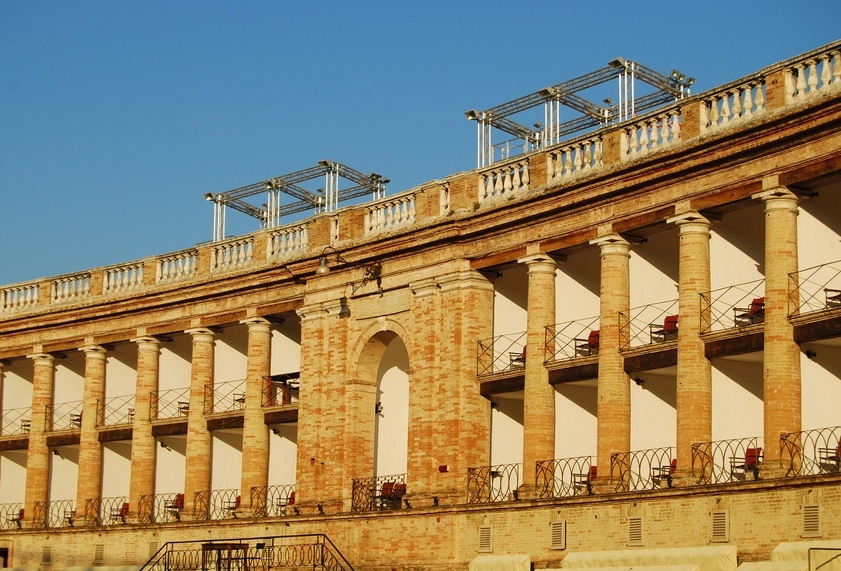
It also has the extraordinary Sferisterio, an enormous neo-classical arena built in 1820 by public subscription. Every Summer a world famous open-air opera festival is held here. I was entranced by the thought that Macerata’s citizens had loved opera enough to build their own venue until I learned that it was originally erected to stage games of that other great Italian passion, soccer. Or, more specifically, pallone col bracciale. A hugely popular sport from the mid 16th to early 20th century, pallone players were once the highest paid athletes in the world.

The pallone field is distinctive in that it has a lateral wall for rebound of the ball. In effect it’s a half arena, an ovoid split down its length and perfectly designed, ‘post-pallone’, to morph into an open-air opera venue. With dozens of private boxes situated between soaring columns, dramatic accent lighting and perfect acoustics, the Sferisterio has become world famous. 


Sferisterio - Photo by Drimi
But it’s not just about universities and opera. The Corso Matteotti is lined by beautiful palazzi reminding us that although this region was traditionally quite poor, relying on agriculture and crafts, it was under local lords for much of its history. Amongst the most distinguished palaces is Palazzo Marefoschi. In this grand house Bonnie Prince Charlie, ‘the Young Pretender’, was married in 1772.

Palazzo Marrefoschi, photo by Mi Ti, Fotolia.com
One of the most attractive aspects of Macerata and the region in general, is that the citizens speak little or no English. Local restaurants don’t spruik for business by cycling competently through half a dozen languages till they hit on yours and no one at the hospital, including doctors, spoke English (which I found to my cost). It has all the hallmarks of real life in a regional Italian town rather than a made for tourists experience.

For my next book I’m heading to the Australian outback. I love the huge horizons, vibrant colour, and eccentric characters found in this vast area. Beyond that, Colorado and New Mexico are on the radar for next year. I’m keen to see the Pueblo de Taos adobe structure in Taos and to experience the artistic communities of both Taos and Santa Fe. I’m sure there’s a story in there somewhere.


Thursday, November 15, 2012

The Well-Traveled Cucumber

By Patricia Winton

What could be more British than afternoon tea with cucumber sandwiches and cake? There might be other things served as well, scones or buns, sandwiches with fillings of fish or meat, but the cucumber variety is de rigueur. However difficult they are to eat with their leaky, slippery filling, cucumber sandwiches are as British as, well, the Queen.

So how did it all start? Cucumbers, it seems, first traveled to Britain with the Roman invaders (ca. 43-400 AD). By the time their conquest began, cucumbers were standard fare in Rome. The Emperor Tiberius (42 BC–37 AD) was a great cucumber lover. Pliny writes that he ate them every day. In fact, Tiberius created movable frames mounted on wheels that could be rolled into the sunshine and moved back to protected space during the cold. This device enabled him to eat cucumbers year round, a precursor to the modern greenhouse.

Cucumber sandwiches did not appear on the scene until long after the Romans departed. Anna, seventh Duchess of Bedford, began the custom of afternoon tea in the early 19th century. A greedy gal, so the legend goes, she found it impossible to wait until dinnertime and had her servants prepare a snack for her in mid-afternoon. Her friends duplicated her repast, and a tradition was born. By the height of the Victorian era, afternoon tea had become an ingrained habit, and these little cucumber treats ruled the tea table.

Proper cucumber sandwiches have three ingredients: thin slices of dense white bread with the crust removed, butter, and cucumbers slices—also thin. The first time I saw someone British make them, she spread butter on the unsliced bread before cutting it. This method, she explained, allowed her to cut thinner slices which would have crumbled if she had tried to spread the butter after cutting. The cucumbers are placed on the buttered bread and topped with a twin. Each sandwich is cut in half, usually diagonally, then in half again to produce four small tidbits.

These little bites accompanied tea in the drawing room and on the cricket pitch for a couple of centuries, though the tradition may be waning now. When the British colonized India, they took their cricket with them, though it was some time before the locals were allowed to play. With cricket came the tea break and cucumber sandwiches.

The sandwiches came with the cricket, but not the cucumber. You see, the cucumber is a native of India. It made its way to Rome when trade routes opened between the two during the reign of Augustus, who preceded Tiberius as Roman emperor. So Tiberius was enamored of a new, trendy vegetable when he created his growing frames.

Today, cucumbers are grown on almost every continent and global production in 2010 reached 57,559,836 tons. How they traveled to other countries I can’t say, though probably without armed intervention. They certainly went from India to Rome without military might, but the trips to Britain and back to India again resulted from conquests.

Please join me on alternate Thursdays at Italian Intrigues where I write about Italian food and wine, mystery and crime.

Wednesday, November 14, 2012

Two (Western) Holidays in One

By Beth Green

It’s holiday season again.

My relatives and friends in the U.S. have already started groaning about the incessant drone of shopping-mall carols, the thought of making lists and checking them twice, and the old rant that Christmas comes earlier every year. It makes a nice change, Facebook-reading-wise, from all the election posts, but mostly it draws my attention to the way the end-of-year holidays are celebrated differently all over the world, and the way facets of American culture have been adopted in Asia.

A Christmas tree vies for attention with one of the old towers of Xi'an

This year, in the Philippines, I’m looking forward to seeing how this overwhelmingly Christian country celebrates Jesus’ birth. The Christ figure is revered here, and Christmas carols started up, right on time, in late September.


But I’ll never forget how the decidedly not-Christian country of China has unofficially adopted the spirit of two western holidays—Halloween and Christmas—and turned them into one big mash-up of fun and partying at the end of December. 


The first year I spent in China, 2006, my partner and I took advantage of the long Christmas weekend given to the foreign English teachers at the school we were working in and flew up to Xi’an with some friends. Xi’an is the home of the Terracotta Warriors, one of the must-see sites in Asia. I was thrilled that we were going to see this historic place, and while a little bit homesick as always over the last two weeks of December, I didn’t mind skipping the holiday that year.

Larger-than-life Santas for sale on the sidewalk in Xi'an.

So I was truly surprised to find Xi’an all dressed up for a party. A huge Christmas tree, lights everywhere (well, Chinese cities usually have lights everywhere, but this was more than normal) and yes—even in the city that started the Silk Road—Christmas carols. 


We toured the Warriors in the daytime, and then in the evening headed over to the Muslim Quarter (one of Xi’an’s ancient districts) to have dinner. The fun of eating Muslim fare on Christmas in China was not lost on us. On the way, we met throngs of people out for a stroll. 


Sidewalks in China can get crowded, and what with one-point-however-many-billion people you see why, but these groups of people were mobbing the pavement. Vendors selling balloons and pinwheels (which are often bought in China on holidays as they’re believed to blow luck to you) did roaring business. Groups of girls wearing glowing devil’s horns over bright orange clown’s wigs tried to take sneaky pictures with us foreigners. Small children carried water-filled bags of tiny goldfish their parents had bought them—it wasn’t Christmas, it was a Halloween Carnival!

Twelve months later I looked forward to the spectacle, and thought I was prepared for it. To research a potential new job, my partner and I flew to another city over Christmas. We made sure we brought our cameras, even though it was primarily a business trip, and asked at the hotel for the best way to get downtown. This year, we decided, we wanted to photograph the action. 

A "snow" fight in Guiyang.

However, if we thought the broad avenues of Xi’an were flooded with people, we hadn’t anticipated what the narrow city streets of Guiyang, Guizhou province, would feel like when everyone was in good-time mode. 


Guizhou province is poor, and a lot of people from there go find work in the more prosperous east. The people who stay behind work hard for small wages. And apparently, love a chance to party. In Xi’an by comparison, our experience had been kind of sedate: groups of people walking, snapping photos and snacking. In Guiyang, bands of young men were ‘attacking’ gangs of young women with cans of silly string.  The laughing women would retaliate with aerosol cans of colored fake snow—the kind you use to frost and decorate windows in holiday season. By the end of a couple of hours on the street, you could spot the married men—they were the ones the girls had left out of the snow-fight.

Devil's horns on Christmas? Why not?

My favorite sight that night was a trio of girls, winter jackets and blue jeans completely covered in wads of silly string and blasts of fake snow, holding roses some boys had given them. They were writing words on the sidewalk in silly string, and then lighting the messages on fire. They had a hard time getting space on the sidewalk to do this, but once they announced their intention, they got plenty of area protected by the crowd of onlookers, myself included. To my English-teaching delight, they mostly wrote English words, “hello!” burned brightly, and then “I love you.”


I can’t remember now if anyone wrote, “Merry Christmas,” but the holiday was celebrated, all the same.

[Note: Read more about Beth’s trip to Xian  here , the trip to Guiyang here  ]

Tuesday, November 13, 2012

Tatars, Mongols and Hordes, Oh My!


By Kelly Raftery

Back in the olden days, when I completed my Russian Studies degrees, we were taught about something that was referred to as the “Tatar Yoke.”  This rather inaccurate term referred to the Mongol (not Tatar) invasion and control of the burgeoning city-states that would eventually become Russia in the 13th to 15th centuries. 

Many an evening I would sit around a table groaning with food, consuming small crystal glasses of ice-cold vodka toasts and then listen, fascinated, as a Russian who was sharing the meal would begin to expound on the evils done by the “Tatars” to Russians, Russia and the world in general . This was not a philosophical, historical argument, but a heated, emotional presentation about if only Russia had not been invaded by the Golden Horde, it would be a modern, western democracy today. My host would often describe how the Mongols killed indiscriminately, devastated the embryonic Russian systems of governance and religion, introduced “oriental despotism” and made Russia a “backwards” society, which lagged by hundreds of years behind Europe. “What would Russia be today, if not for those filthy, barbaric Mongols?!?!” seemed to be the summary statement of every prolonged speech detailing of the evils of the Mongol Invasion.

A Russian depiction of the Golden
Horde's attack on Suzdal.

Now, as an American, this always struck me as odd, mostly because if you ask an American about, say, their feelings regarding the American Revolution, you would probably get a shrug and “Uh, um...it was a good thing?”  No one in my country could expound emotionally on the crimes against nascent American society committed by the British, and really, much of our history is something we find only in history tomes. But, in Russia, the Mongol invasion was (and is) a deeply personal subject and its negative influences on society were evident and regretted to modern times.

Fast forward a decade or so and I find myself married to someone who may very well be descended from Genghis Khan (an astounding eight percent of men alive today in the former Mongol Empire are, read a bit more about this factoid here) and my perspective shifts to wonder about what the impact of those Mongols on Russia really was. Which is not to assert that the Mongols were nice, peace-loving herders who asked pretty please before they invaded every civilization between the Pacific and the Caspian, but I have often noted that history’s narrative is quite variable, depending on point of view.

Mongol warriors in battle.

The current view of Mongol dominance over Russia is that while brutal initially, over time, it essentially became a financial agreement, by which the ruling lords of Russia paid a tribute to the Golden Horde and for the most part, they were left to their own devices. (An interesting side note is that the Russian word for money—dengi—is one of many bits of vocabulary left behind by the Mongols, along with loshad’ (horse), bazaar (market) and sunduk (wooden chest).)  As long as the money kept coming, the Mongols had no interest in imposing their worldview on the Slavs, or any of the other peoples that they conquered. In fact, the Russian Orthodox Church emerged after two centuries of Mongol rule stronger than it had been previously. However, if a municipality decided that it was no longer interested in paying the Mongols, retribution was swift and harsh.  

After its collapse, the Golden Horde left Russia a postal system, military and government organizations. Russian princes adorned themselves in silks and indulged in other luxuries that only efficient Mongol operation of the Silk Road made possible. The Mongol invasion and occupation also helped to bring forth the concept of a united Russia. On September 8, 1380 Prince Dmitry Donskoi united multiple Princes of Slavic city-states into one united Russian force to fight off the Mongols during the Battle of Kulikova. While the Mongols did not actually leave for another hundred years, this temporary victory is often pointed to as the key moment that formed the Russian nation.   

With time, the Mongol influence on Russia will be reevaluated and reconsidered, based on new evidence and perspectives. But, one cannot deny its lasting impact. As the Russian proverb proclaims, “Scratch a Russian and you will find a Tatar."